
Norse Mythology · Cosmological myth / belief in writing
The World Tree and the Runes
One ash tree holds up the nine worlds, and the chief god hangs on the tree for nine nights — the Norse wrote the universe as a tree, and writing itself as a sacrifice.
Stories and legends
The World Tree Yggdrasil is an evergreen giant ash, its three roots reaching respectively toward the land of the giants, toward Asgard, and toward the underworld; beneath its underworld root are the well Hvergelmir and the venom-dragon Níðhöggr gnawing at the roots; in its crown an eagle perches and a stag feeds on its leaves, and the squirrel Ratatoskr runs up and down between the eagle and the dragon, carrying messages and stirring mischief. Three springs determine the order of the world: beside the Well of Urðr, the three Norns, goddesses of fate, smear the roots daily with spring water and mud and weave the lifespans of all beings; the Well of Mímir hides wisdom, and Odin pledged one eye to drink from it; beneath the tree is the judgement court where the gods ride daily across the rainbow bridge to assemble. The story of the runes belongs to Odin's self-sacrifice: he tells it himself — "I was offered to Odin, myself to myself" — hanging on the tree for nine nights, wounded by a spear, without food, and as he stared down into the abyss he picked up the runes: writing was not invented, it was bought with suffering. And so the runes are both letters and charms: carved on a sword to seek victory, carved on stone to record a name, carved on a slip of wood to send a feeling. The World Tree ages, is gnawed, and at Ragnarök will tremble but not fall (one account says it still stands after the fire) — the image of the universe is not a palace, but a living thing that must be watered every day.
Origins of the story
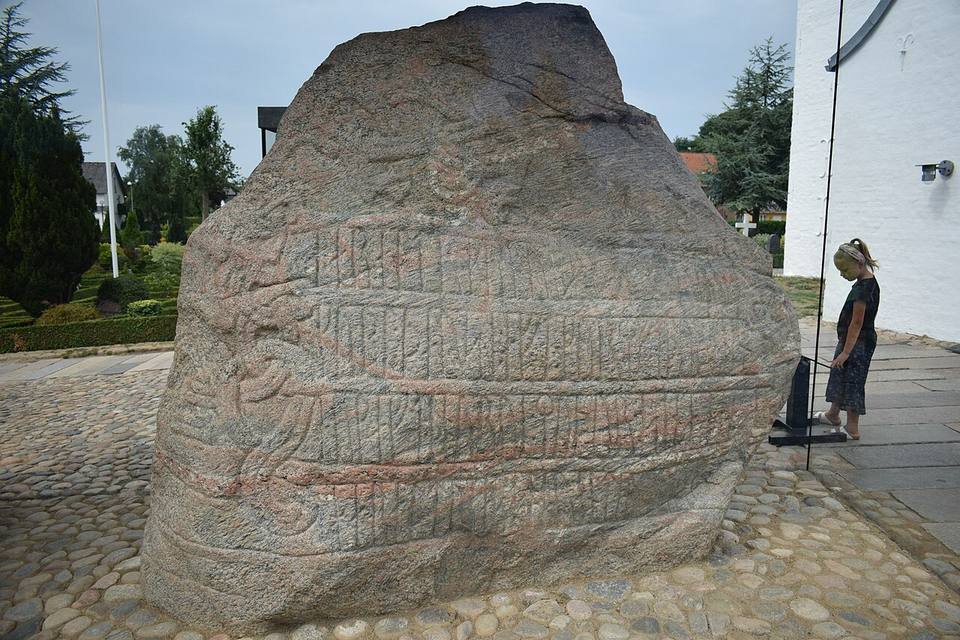
The Poetic Edda — Völuspá (女先知预言), Grímnismál (格里姆尼尔之歌), and the rune stanzas of Hávamál (奥丁智慧诗) — and the Prose Edda are the textual sources. The runic alphabet (the Elder Futhark, from about the 2nd century) is a real historical writing system, with some thousands of inscriptions extant, the great majority of a naming and memorial character; "magical use" forms only a limited proportion of the inscriptions and must be distinguished from New Age mystical elaborations. The Great Jelling Stone (erected by Harald Bluetooth around 965) sets a figure of Christ and a runic inscription side by side — physical evidence of the pagan–Christian transition; the interlaced great-beast carving on the north door of Urnes Stave Church (older timber of about 1070) has been read by some scholars as an image of the World Tree / Níðhöggr (one interpretation, not settled).
Customs
Most rune stones are open-air protected relics — rubbings, climbing, and touching the mossy surfaces are strictly prohibited (they accelerate weathering); the stave churches are timber national treasures — no flash photography or open flames inside, and some churches are still places of worship, so visit outside service hours and keep quiet; do not buy tourist souvenirs claiming to be "ancient rune amulets" as if they were antiques — the overwhelming majority are modern craftwork, and labelling them as such is sufficient.
Places you can visit
Jelling in Denmark (the Jelling stones, the royal mounds, Jelling Church, and the "Kongernes Jelling — Home of the Viking Kings" experience centre, a UNESCO site); the rune-stone fields around Uppsala and Sigtuna in Sweden (inscriptions at their open-air original sites); Urnes Stave Church in Norway (UNESCO) and Borgund Stave Church (dragon-head gables, interlaced carving on the door frames); rune exhibits at the National Museum of Iceland. Opening times at each site are as officially announced each year.
Image source · Ljunie · CC BY-SA 4.0