
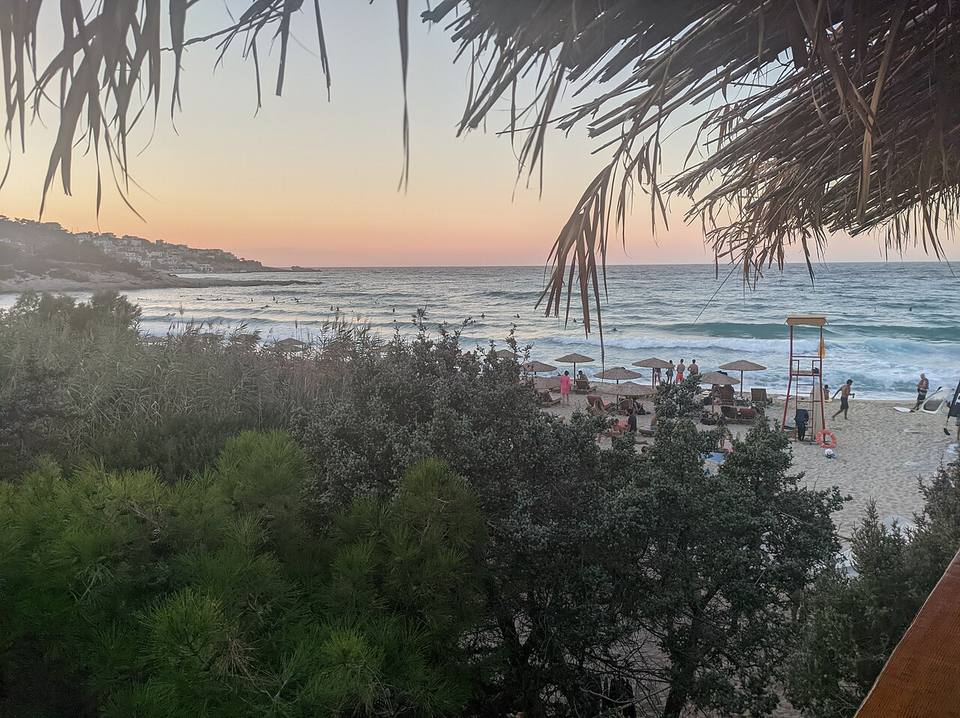
Greek Mythology · Artisan myth / cautionary tale
The Fall of Icarus
His father gave him wings and one instruction — fly not too high, and not too low — and the boy remembered only half of it.
Stories and legends
Daedalus was Athens' cleverest craftsman; exiled to Crete for murdering his nephew (in one version, his apprentice) out of jealousy, he built the Labyrinth for Minos and secretly gave Ariadne the ball of thread that led out of the palace. Minos, enraged, imprisoned Daedalus and his son Icarus in the Labyrinth (in one version, in a high tower). With the sea routes and land routes both sealed, Daedalus looked at the sky and said: earth and sea can be closed — the sky is still open. He gathered fallen feathers, arranged them by size in an arc, sewed them with thread and stuck them with wax, and made two pairs of wings. Before the test flight he instructed the boy through tears: take the middle course — too low, and the seawater will soak the feathers; too high, and the fierce sun will melt the wax. The boy, flying for the first time, was wild with joy: he skimmed past Samos, Delos, and Paros, flew higher and higher, and left his father far behind. The wax melted, the feathers fell away one by one, and he beat his bare arms in vain, calling his father's name, and fell into the sea; the waves closed over him. Daedalus looked back and could not see his son — only feathers drifting on the surface. He buried his son on a small island, and the island and the sea took Icarus's name from then on. The old craftsman flew on to Sicily and ended his days at the court of King Cocalus of Camicus — and another account says Minos pursued him to Sicily and was instead scalded to death by Daedalus's design in a bathhouse. The story of the wings is told, and the lesson it leaves is self-contradictory and uncommonly true: the danger lies both in hubris and in that instruction most easily drowned out by excitement.
Origins of the story
The complete narrative is found in book 8 of Ovid's Metamorphoses and in Apollodorus's Epitome; Homer's Iliad mentions only that Daedalus made a dancing floor for Ariadne, and the father-and-son flight is a later formation. As for the naming of the island of Ikaria, its official history page explicitly lists several accounts: the Icarus theory circulates most widely, and there are other theories such as a Phoenician etymology; this entry follows the plurality of accounts and labels them. In the Chrysostomos area of the island there are a monument to Icarus and a modern commemorative installation with a small summer theatre (a local culture-and-tourism facility).
Customs
At Ikarian village festivals (panigyri), dancing and drinking go on all night; visitors may join the circle and dance, but do not seize the lead-dancer's place and do not cause drunken trouble; the coasts are windy and wavy — when taking commemorative photos, do not climb on wet, slippery rocks: Icarus's lesson begins with safety; the island's mountain roads bend sharply, so drive with extra care at night.
Places you can visit
The island of Ikaria (Agios Kirykos, the rocky shores and the locally identified points of the "Rock of Icarus," the area of the Chrysostomos monument); Knossos on Crete (the story's starting point, to be read together with entry 18); the island of Samos (a node on the flight route). Village festivals (panigyria) on the island are frequent in summer; dates are as officially announced each year.
Image source · Leeturtle · CC BY-SA 4.0
