
Greek Mythology · Heroic epic / tale of a monster
The Minotaur and the Labyrinth
A bull-headed, man-bodied monster dwelt at the centre of a maze no one could escape; an Athenian prince walked out of it by a ball of thread and a princess's heart.
Stories and legends
Minos, king of Crete, begged the sea god Poseidon to grant him a white bull as proof of his kingship, but once the thing was done he could not bear to sacrifice it. Poseidon punished his wife Pasiphaë by making her fall in love with the white bull, and she bore the Minotaur, bull-headed and man-bodied. The monster ate human flesh, and Minos ordered the master craftsman Daedalus to build the Labyrinth to imprison it beneath the palace of Knossos. Minos's son was killed in Athens (in one version, he died in the games), and Minos made war; Athens was forced to send, every nine years (in one version, every year), seven youths and seven maidens as tribute to feed the monster. At the third tribute, the Athenian prince Theseus volunteered to be among them; Princess Ariadne fell in love at first sight and gave him a ball of thread and a sword: tie the thread at the door as you enter the palace, follow the thread to kill the monster, and follow the thread out. Theseus cut off the bull's head, led the others aboard ship by night, but on the way home abandoned Ariadne on the island of Naxos (the wine god Dionysus afterwards married her, by one account), and forgot his pact with his father Aegeus to "hoist white sails if he returned alive" — the ship came home under black sails, Aegeus, believing his beloved son dead, threw himself into the sea, and that sea has been called the Aegean ever since. A story about a monster ends, in its close, on the separate fates of three people.
Origins of the story
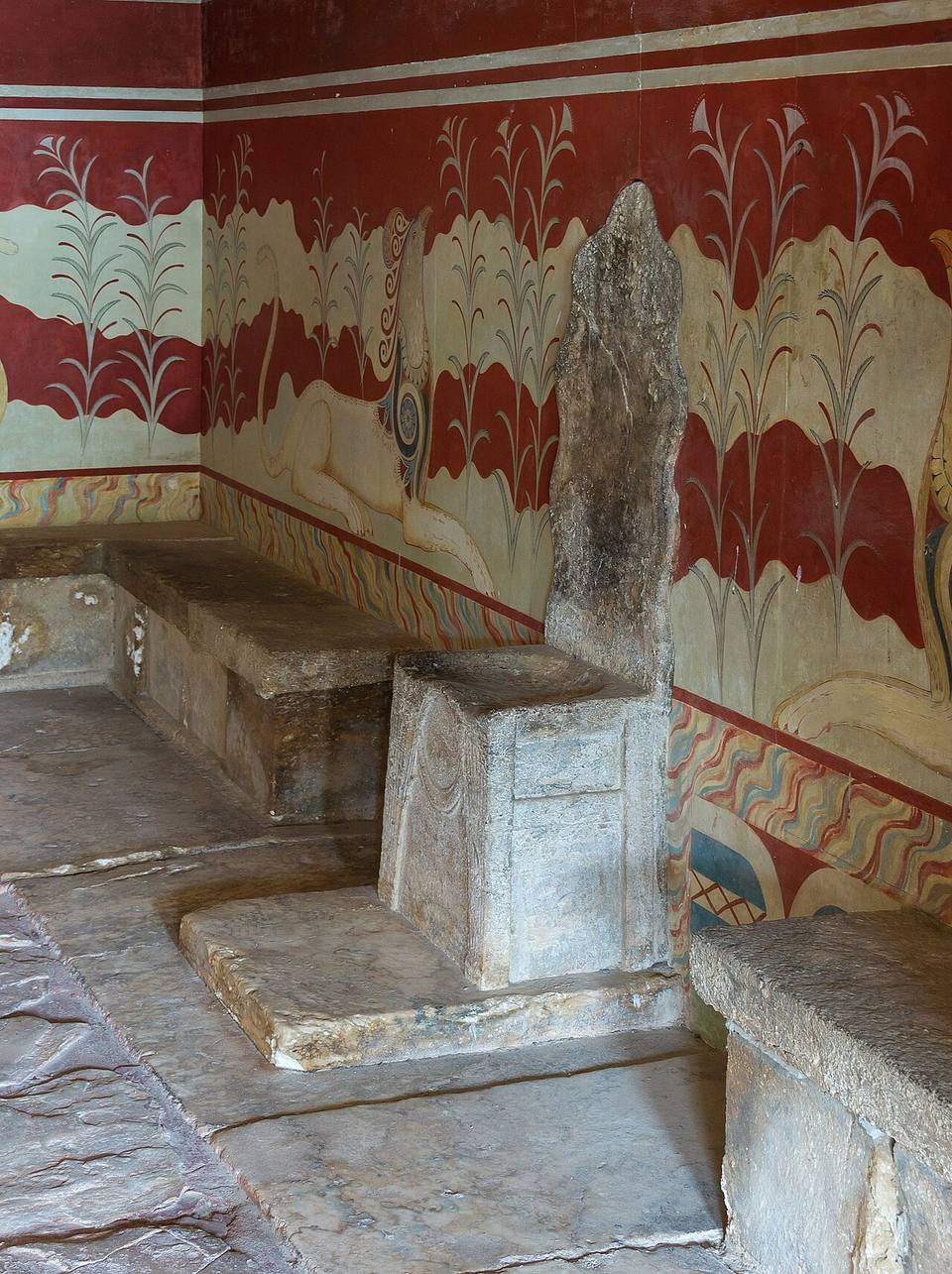
The story is found in late compilations such as Apollodorus's Library (书库) and Plutarch's Life of Theseus; Homer mentions only that Daedalus made a dancing floor for Ariadne. Archaeologically, the palace of Knossos was the centre of the Minoan civilisation (flourishing c. 2000–1450 BCE); Evans excavated it from 1900 and restored large areas in concrete, and the scale of his restoration remains academically controversial to this day; the "labyrinth" may be connected with the palace's complex plan and with the etymology of "labrys (the double axe)" — a scholarly hypothesis. The tribute system may be a mythicised memory of Athenian subjection to Cretan sea power (Thucydides already offered this rationalising reading).
Customs
When you cannot tell restored areas from original fabric at the site, do not improvise explanations — follow the official guided-tour account; do not cross the fences to touch the fresco reproduction surfaces; the Cretan sun in summer is extremely strong — enter early in the morning and bring water and sun protection; no flash photography of the Linear-script exhibits in the museum.
Places you can visit
The palace site of Knossos on Crete (the throne room, reproductions of the dolphin frescoes in the queen's apartments, the central court); the Heraklion Archaeological Museum (original frescoes, the bull-leaping fresco, the snake goddess figurines, the Phaistos Disc); the palace of Phaistos can serve as a comparison. The site holds no regular myth festival; special exhibitions are as officially announced each year.
Image source · Jebulon · CC0
