
Greek Mythology · Athletic-sanctuary myth / heroic epic
Olympia and Zeus: The Origins of the Ancient Olympic Games
The starting point of the Olympic Games is a chariot race rigged to win a bride, and a king condemned to death by an oracle.
Stories and legends
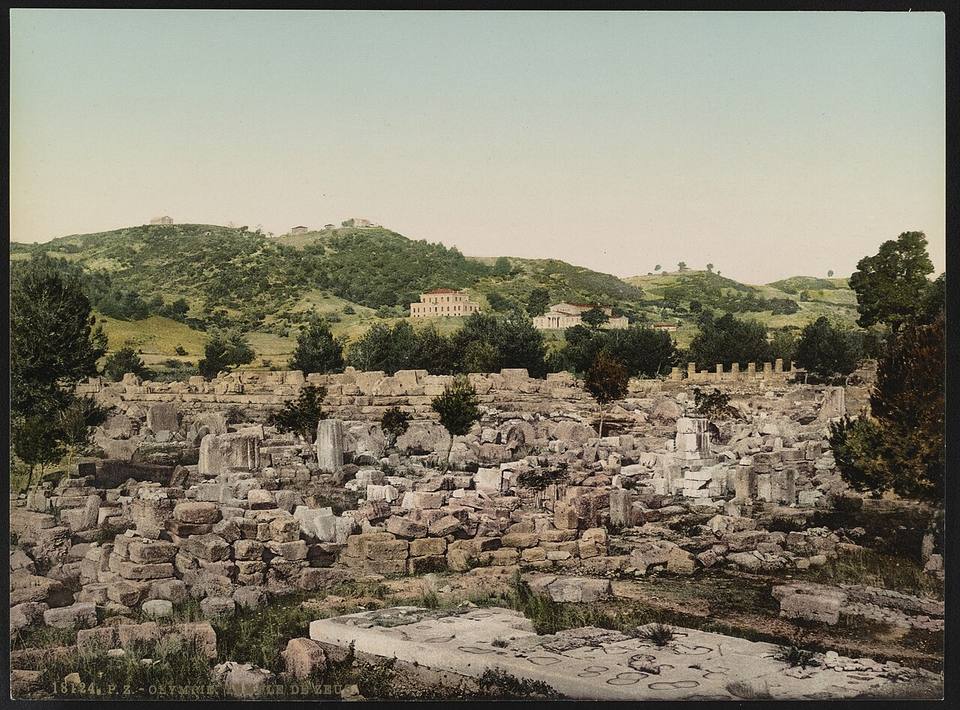
Several origin accounts coexist; this entry takes the most widely circulated, that of Pelops. Pelops, a prince of Phrygia exiled to the Peloponnese, sought to marry Hippodamia, daughter of Oenomaus, king of Elis. The king had received an oracle that he would die at the hands of his son-in-law, and so laid down a rule: a suitor must carry the bride away in his chariot and flee; whoever failed to escape would be beheaded and displayed — thirteen suitors (the number varies between accounts) had already become heads on the city wall. Pelops bribed (in one version, won over by love) the charioteer Myrtilus, who replaced the king's axle-pins with wax so they would loosen; in the race the wheels fell away, the king was thrown from the chariot and died, cursing the charioteer with his last breath; and Myrtilus was then pushed into the sea by Pelops (in one version, because Pelops broke his promise) — this chain of curses is precisely the source of the curse of kin-slaying on the house of Atreus afterwards. Another origin account credits Heracles: after cleaning the Augean stables (in one version, in celebration of it), he marked out the sacred precinct at Olympia and measured out the first "stade" racetrack. To commemorate this history, all Greece held a truce and competed every four years in the sanctuary of Zeus at Olympia, and the victor received only an olive crown — honour itself was the prize. The east pediment of the Temple of Zeus carved exactly the moment of confrontation before Pelops's race, with Zeus standing at the centre, already knowing the outcome.
Origins of the story
The ancient Olympic Games are traditionally dated from 776 BCE and ended in 393 CE (by one account, with Theodosius's prohibition of paganism); Pindar's Olympic Odes and books 5–6 of Pausanias's Description of Greece are the core documents. The Temple of Zeus was built c. 470–457 BCE; Phidias's gold-and-ivory statue of Zeus, erected in the temple around 435 BCE, ranked among the Seven Wonders of the Ancient World and is now lost, with only its workshop site, tools, and mould pieces surviving. Olympia was inscribed on UNESCO's World Heritage List in 1989; the Pelops and Heracles accounts of the origin myth have run in parallel since antiquity and need no reconciliation.
Customs
You may run on the stadium track for the experience, but do not climb on the altar areas or temple foundations; during the flame ceremony, obey the cordon lines; the pine woods of the site are a fire risk — flames and smoking are strictly forbidden; no flash photography or tripods in the museum's Hermes gallery.
Places you can visit
The Olympia archaeological site (the Temple of Zeus, the Temple of Hera, Phidias's workshop, the vaulted entrance and track of the ancient stadium, the oath platform); the Archaeological Museum of Olympia (the original pediment sculptures, the Hermes attributed to Praxiteles, the Nike statue); the Museum of the History of the Ancient Olympic Games. The modern Olympic flame-lighting ceremony is held before the Temple of Hera (in each Olympic year; dates as officially announced each year, including public explanations of the rehearsal lighting).
Image source · Photoglob Co., publisher · Public domain

