
Greek Mythology · Tale of the underworld / myth of music
Orpheus and the Gates of the Underworld
His lyre made the King of the Dead weep — yet in a single backward glance, he lost his wife a second time.
Stories and legends
The Thracian singer Orpheus was the son of Apollo (in one version, of Oeagrus) and the Muse Calliope; his lyre could make stubborn stones shed tears and wild beasts bow their heads. On his wedding day, his wife Eurydice was bitten by a viper in the grass and died (in one version, she stepped on the snake while fleeing the pursuit of Aristaeus). Orpheus descended alone into the underworld with his lyre: his song softened Cerberus, halted the wheel of Ixion, and made even the Furies shed tears; Hades and Persephone allowed him to lead his wife back, on the condition that before leaving the underworld he must never look back at her. Through the long darkness he could not hear the footsteps behind him (in one version, he suspected the gods were deceiving him), and just as they were about to leave the cave, with the first ray of sunlight in sight, he could not help looking back — Eurydice had time only to say one word of farewell before sinking a second time into death. Orpheus was refused a second crossing by the ferryman of the Styx, fasted and sang in grief for seven months, and was finally torn apart by the frenzied maenads of the wine god (in one version, because he rejected Dionysus / scorned women); his head floated down the river to the island of Lesbos, still singing. It must be stated honestly: the Nekromanteion of Acheron, bound to this entry on the ground, has as its most direct textual correspondence the summoning of the dead in the Odyssey (see History and Origins); Orpheus's journey to the underworld is located in the ancient tradition mostly in Thrace / Taenarum. The two belong together to the Greek geography of the underworld, of "the living questioning the dead," and are presented side by side without conflating their locations.
Origins of the story
The complete narrative of Orpheus's descent is found in book 4 of Virgil's Georgics and books 10–11 of Ovid's Metamorphoses; the classical Greek period has only fragmentary mentions, and the name Eurydice is also a later fixing. The Nekromanteion (the oracle of the dead at Ephyra) is recorded in book 5 of Herodotus's Histories, in the account of Periander sending men to question the ghost of his dead wife; the site was excavated from 1958. The excavator, Dakaris, identified it as an oracle of the dead, but later scholars have proposed the dissenting view that it was a Hellenistic fortified farmhouse (an academic controversy); the Greek Ministry of Culture still officially presents it as a necromanteion, and guides to visitors should mention both views.
Customs
The underground hall is dim and its steps steep — do not leave your group to probe "dark passages"; the Acheron spring water is extremely cold, so do not dive in head-first when playing in the water, and supervise children throughout; do not perform ritual "spirit-summoning" theatrics at the site — respect the archaeological scene; the riverside villages are quiet at night, so do not make noise.
Places you can visit
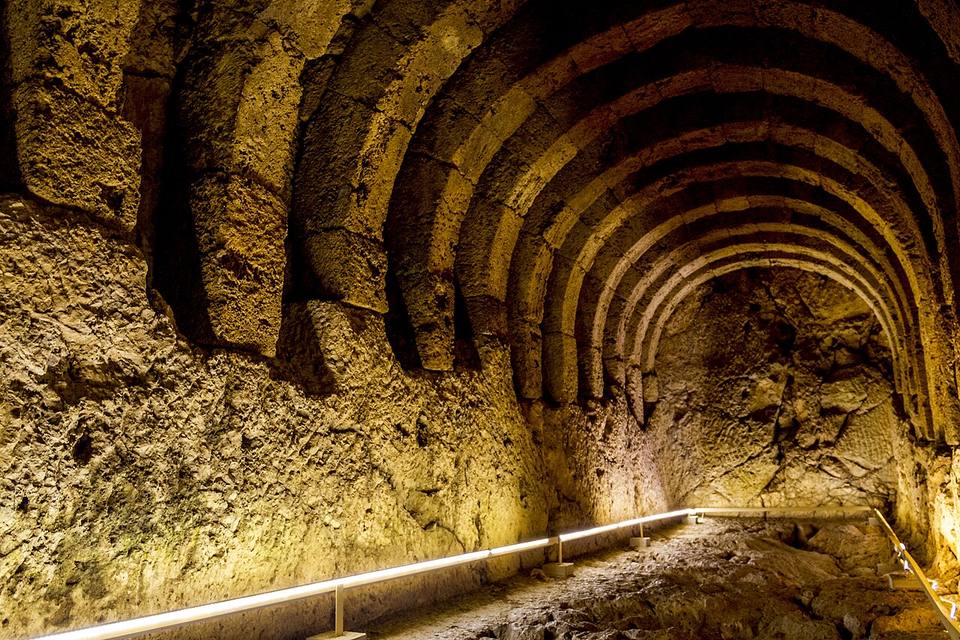
The Nekromanteion site on the Acheron river in Epirus (on the hill of the village of Mesopotamos, with polygonal walls, labyrinthine corridors, and an underground vaulted, tomb-like hall); the springs area of the Acheron at Glyki (cold-spring walking trails); the Archaeological Museum of Ioannina (related finds); the island of Lesbos (the legendary place of Orpheus's head, an extension). The site's open seasons are as officially announced each year.
Image source · Dionysisa303 · CC BY-SA 4.0