
Greek Mythology · City-state guardian myth
Athena's Athens: The Contest of the Olive and the Sea God
The sea god struck out a salt spring; the goddess planted an olive tree — and the Athenians, reckoning by their livelihood, chose their guardian deity with one vote.
Stories and legends
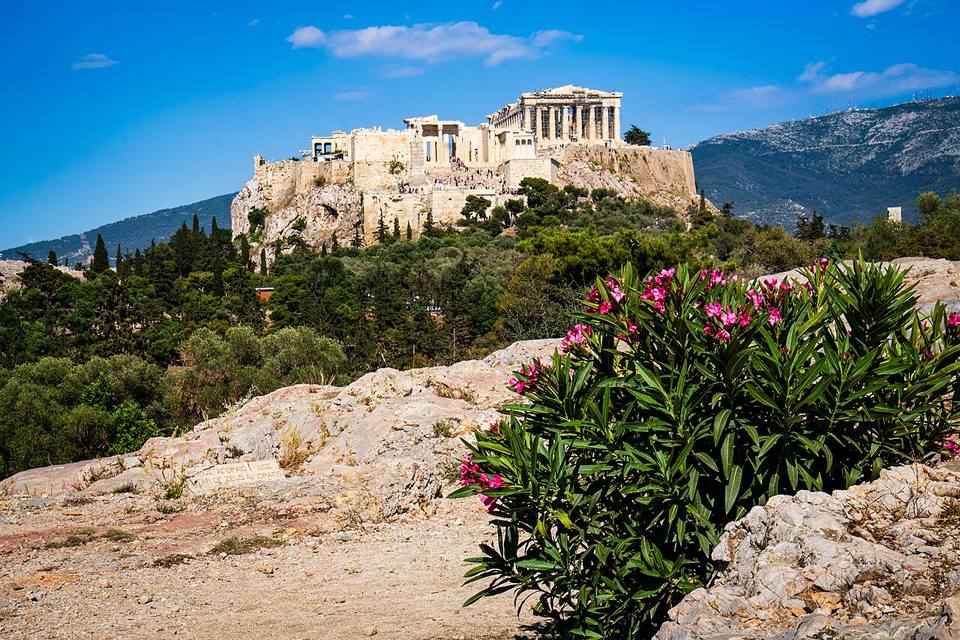
In the reign of Cecrops, Athens' first king, half man and half serpent, Poseidon and Athena contended for the guardianship of Attica. The gods decreed: whoever gave humankind the more useful gift would win the city. Poseidon first ascended the rock of the Acropolis and struck the rock hard with his trident, and a spring of seawater gushed out (in one version, a fine horse leapt forth at the same time, symbolising military power); Athena then lightly touched the ground with her spear, and an olive tree broke through the soil, its branches hanging low. Cecrops bore witness: the olive yields oil, fruit, fuel, and shade, and can feed a city; the salt spring cannot quench thirst. The gods (in one version, the citizens of Athens) judged Athena the winner, and the city took her name — "Athens." Poseidon in his anger flooded the Thriasian plain to vent his wrath, and (in one version) cursed Athens with a chronic shortage of water; the Athenians, for their part, worshipped both gods together on the Acropolis — in the Erechtheion they venerated both Athena's ancient olive-wood statue and the marks of Poseidon's trident in the rock and the salt well, and beside it grew a descendant of the "sacred olive." Even a god who lost must not be offended: this is the most worldly-wise, and most truthful, lesson of Athenian myth. That olive, on the day after the Persians burned the city, put out new shoots from its charred trunk (by one account, in Herodotus), becoming the totem of the city-state's rebirth.
Origins of the story
The contest for the city is found in Apollodorus's Library 3.14 and Pausanias's Description of Greece 1.24–27; the west pediment of the Parthenon carved exactly this subject (most of the originals are lost; the composition depends on Carrey's drawings of 1674). The Erechtheion is a composite sanctuary, and scholars regard its irregular plan as the result of multiple cults set side by side. The Acropolis was inscribed on UNESCO's World Heritage List in 1987; the present sacred olive is a commemorative planting said to descend from the tree burned by the Persians (by tradition, replanted from the root suckers of the original after it died), presented as a memorial tradition.
Customs
The marble surfaces of the Acropolis are polished slippery — wear non-slip shoes; picking up any stone fragments is forbidden (it is illegal); do not touch the branches and leaves within the sacred olive's fence; in the museum's Caryatid gallery, do not lean on the display stands when it is crowded; pace yourself on the climb at midday in high heat.
Places you can visit
The Acropolis of Athens (the Parthenon, the Erechtheion and the sacred olive, the Temple of Athena Nike, the Propylaea); the Acropolis Museum (the original pediment sculptures; five of the original Caryatids are in the museum (the sixth is in the British Museum), and those on the building are replicas); an extension to the National Archaeological Museum. The Panathenaea was an ancient festival with no official modern revival; related activities are as officially announced each year.
Image source · Andrew Parlette · CC BY 4.0

