
Greek Mythology · Oracle belief / sacred-site myth
The Oracle of Delphi: Apollo and the Pythia
Before going to war or founding a colony, every city-state in Greece first came to this mountainside to hear a priestess speak in riddles.
Stories and legends
To fix the centre of the earth, Zeus released two divine eagles from the two ends of the world; the eagles met at Delphi, and the stone set at their landing point was the Omphalos — the navel of the world. The place was originally held by Python, the giant serpent child of the earth mother Gaia (in one version, a female dragon, Delphyne). The young Apollo came from Delos and shot the serpent dead with his divine arrows; the serpent's corpse rotted in the sunlight, and the place was named "Pytho" for it (taking the sense of "to rot"); Apollo then turned into a dolphin and seized a Cretan merchant ship, commanding its crew to be his priests. After atonement and purification he founded the oracle here. The priestess Pythia sat on a tripod in the inner chamber of the temple, over a fissure in the earth (so the ancients believed) and chewing laurel leaves, and uttered divine words in a state of frenzy, which the college of priests then polished into hexameter verses. The oracle was famous for its ambiguity: Croesus, king of Lydia, asked whether he should attack Persia, and the answer was, "Cross the river Halys and you will destroy a great empire" — the empire he destroyed was his own. The ending is written into its style: Delphi gives no answers, only a mirror that requires wisdom to read. After the Hellenistic age the oracle gradually declined, and at the end of the 4th century CE it ended with the prohibitions on paganism; the last transmitted oracle (by one account a later composition in its voice) sighs: the spring has run dry, the laurel is silent.
Origins of the story
The sanctuary arose in the 8th century BCE and its influence peaked in the 6th century BCE; the Homeric Hymn to the Pythian Apollo is an early text, and Herodotus and Plutarch (who served as a priest at Delphi) record much about it. The theory that the Pythia "inhaled hallucinogenic gases" was advanced in a geological study of 2001 (the ethylene hypothesis) and has since also been questioned; it is not settled, and the main text does not state it as fact. Delphi was inscribed on UNESCO's World Heritage List in 1987.
Customs
The site's steps are steep and slippery — do not climb or sit on exhibits such as the Omphalos or on the foundation stones of the temple; do not perform loud "oracle-seeking" theatrics inside the sanctuary; no flash photography in the museum's Charioteer gallery; mountain areas have frequent afternoon thunderstorms, and in summer guard against sun and dehydration.
Places you can visit
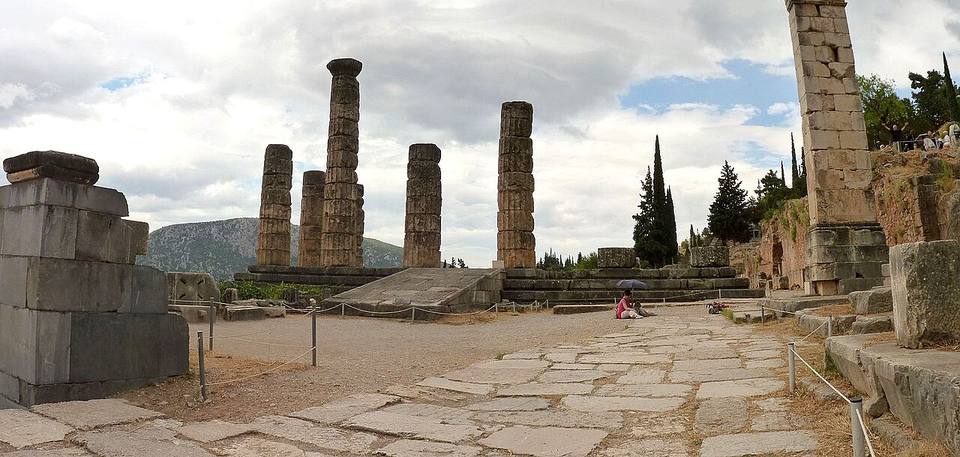
The Delphi archaeological site (the Sacred Way, the Temple of Apollo, the theatre, the stadium, the Tholos in the sanctuary of Athena Pronaia); the Delphi Archaeological Museum (the bronze Charioteer, the Omphalos stone replica, and the Sphinx of Naxos); extensions to Mount Parnassus and the Corycian Cave. The ancient Pythian Games were held every four years and have no modern revival; site festivals follow the museum's activities, as officially announced each year.
Image source · Ronny Siegel · CC BY 3.0
