
Chinese Mythology · Sea faith
The Legend of Mazu
A fisher girl of Meizhou who, after death, became the common mother of all who go to sea — "where there is seawater there are Chinese, and where there are Chinese there is Mazu."
Stories and legends
In the first year of Jianlong in the Northern Song (960, by the traditional account), Lin Mo was born on Meizhou Island in Putian to Lin Yuan; she did not cry at birth, and so was named "Mo" ("the silent one"). As a child she was adept in the water, could cross the sea on a mat, and could foresee fortune and disaster; she often rescued fishing boats in distress amid howling wind and towering waves. The legend tells that once, when her father and elder brother were caught in a storm at sea, she sat at her loom with eyes closed in a trance, gripping the shuttle in her mouth to save her father; her mother, startled, called out and woke her — her brother was never saved, and she blamed herself all her life. One version says that at the age of 28 she ascended Mount Mei on the Double Ninth Festival and became a goddess (another version records in documents only that she was a shamaness who could foresee people's fortunes and disasters in life, and that a temple was built for her after death). The tales of her miracles after deification grew along the sea routes: in the fifth year of Xuanhe of Song (1123), the envoy Lu Yundi, on a mission to Goryeo, met a storm and saw a goddess in red standing on the mast; of eight ships seven capsized and the one he rode alone survived. On his return he petitioned the court, which bestowed the temple title "Shunji" ("Favourable Crossing"). Thereafter Mazu's titles rose through the dynasties — from Lady, to Consort, to Heavenly Consort, to Heavenly Queen and Holy Mother in Heaven — and her branch temples spread across Fujian, Taiwan, Guangdong, and Hainan, to the Ryukyus, Southeast Asia, and Chinese ports around the world. She is not merely a goddess: incense-sharing, ancestral pilgrimages, processions, and sea sacrifices stitch scattered coastal communities into one whole.
Origins of the story
The earliest document is Liao Pengfei's Record of the Rebuilding of the Shunji Temple at the Ancestral Temple of Shengdun (圣墩祖庙重建顺济庙记) of 1150 in the Southern Song, which calls her one who "practised as a shamaness and could foresee people's fortunes and disasters; when she died, the people built a temple for her" — that is, the historical core may be a shamaness; the birth and death years 960–987 are a systematised account of later generations (including Ming-dynasty documents), and scholars treat the details with caution. In 2009, "Mazu Belief and Customs" was inscribed on UNESCO's Representative List of the Intangible Cultural Heritage of Humanity, the first belief-and-custom item from China on the World Intangible Heritage list. The founding of the ancestral temple is traditionally dated to 987.
Customs
On entering a temple, first wash your hands and straighten your clothing, and do not step on the threshold; branch-incense ancestral pilgrimages must be presided over by the temple, and visitors must not touch the statues or the branch palanquins without permission; during ceremonies, do not cross in front of the goddess's palanquin or point at and comment on the statue; seafarers avoid turning a fish over on board and avoid words such as "sink" and "capsize" (coastal fishing custom); when offering flowers and fruit, follow temple rules, and do not offer meat dishes in side halls of ancestral temples that keep a vegetarian-offering tradition — ask the temple keeper first.
Places you can visit
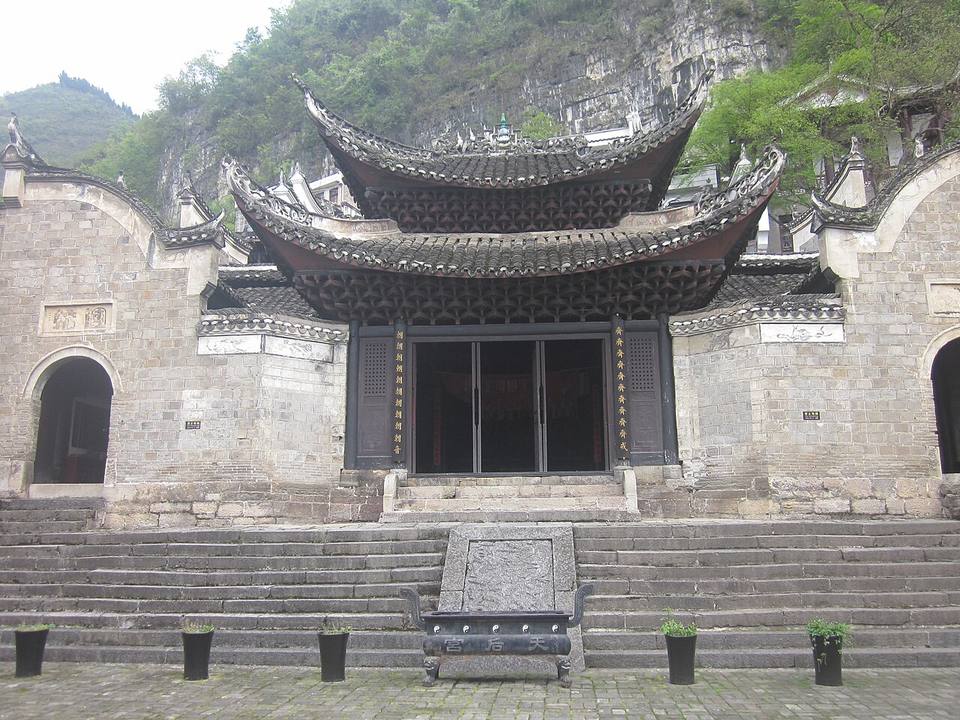
The Mazu Ancestral Temple on Meizhou Island in Putian, Fujian (the architectural complex on Ancestral Temple Mountain, the site of the ascension, the Mazu stone statue; commemorative activities on Mazu's birthday, the 23rd day of the 3rd lunar month, and on her ascension day, the 9th day of the 9th lunar month, as officially announced each year); the Tianhou (Heavenly Queen) Palace in Quanzhou (part of the ancient Quanzhou port architectural complex, a witness to Song–Yuan maritime trade and a related element of Quanzhou's World Heritage inscription); the A-Ma Temple in Macao (a folk-narrative site for the Portuguese arrival in Macao and the origin of the place-name "Macau" from "A-Ma Bay" — part of the layer of local legend); Mazu temples in the north — Tianjin, Yantai, Changdao — show the route by which the faith spread northward.
Image source · Huangdan2060 · CC BY 3.0

