
Chinese Mythology · Heroic epic / flood-control myth
Yu the Great Controls the Floods
The father dammed the waters for nine years, failed, and was executed; the son changed blocking to dredging and succeeded in thirteen — China's earliest "engineering ethics" is written in the flood.
Stories and legends
The floodwaters surged, drowning mountains and overwhelming hills. Yao asked who could control the waters, and the ministers all recommended Gun. Gun stole the Emperor's "breathing earth" (xirang) to dam and block the flood; after nine years without success he was executed at Mount Yu. Shun then raised Gun's son Yu to carry on the work. Yu had learned his father's lesson and no longer met the water head-on: he rode the four conveyances, marked the trees as he followed the mountains, and with Yi and Houji surveyed the land — plumb line in his left hand, compass in his right — dredging the nine rivers, opening the Ji and Luo, breaching the Ru and Han, draining the Huai and Si, cutting through Dragon Gate and clearing the Weak Water, guiding the floodwaters all the way to the sea. In thirteen years he passed his own door three times: the first time, his wife of the Tushan clan had just given birth to Qi and the baby was crying — he did not stop; the second time, the child could call "father" — he did not stop; the third time, the child was over ten years old — he still only called out from outside the gate and went on his way. When the waters receded he divided the land into nine provinces and fixed the tribute according to the soil; the Son of Heaven bestowed on him a black jade sceptre, and Xia was founded thereby. Yu in his later years died while touring Kuaiji and was buried there (one version says he summoned the feudal lords to Kuaiji to reckon their merits, and died there). Later generations carved "three times he passed his home but did not enter" into every temple of Yu — in the end, the story of flood control is not about divine power, but about the measure of putting the public good before oneself.
Origins of the story
The Book of Documents (尚书) · Tribute of Yu (禹贡) and the Records of the Grand Historian (史记) · Basic Annals of Xia (夏本纪) are the core texts; the inscription on the Western Zhou Suigong Xu vessel — "Heaven charged Yu to spread out the land, to follow the mountains and dredge the rivers" — is the earliest documentary material yet seen that mentions Yu (the mainstream scholarly reading of the inscription is accepted). The historicity of Yu and the problem of Xia history are matters of academic debate; this entry treats them only as text and belief. The Shiniu birthplace of Yu is found in the Han–Jin Shu-region documentary tradition such as the Chronicle of the Kings of Shu (蜀王本纪); the Shaoxing burial is found in the Yue-region tradition such as the Jue Shu of Yue (越绝书); the two accounts run in parallel and both belong to later systems of commemorative worship.
Customs
The Yu sacrifice is a solemn state-level ceremony — in the viewing areas do not make noise or cross the cordon lines; in mountain areas such as Shiniu, guard against slippery ground and falling rocks in the rainy season and do not camp on river beaches; when offering incense at Yu temples, follow the proper order, and do not privately make rubbings of stone carvings at flood-control sites (prohibited for cultural-relics protection).
Places you can visit
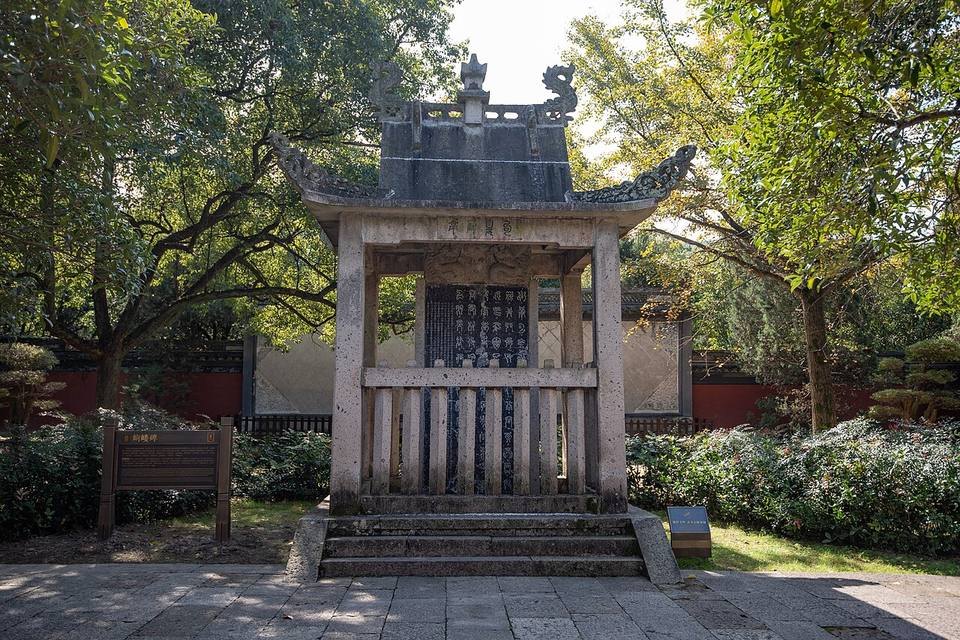
The Mausoleum of Yu the Great in Shaoxing, Zhejiang (at the foot of Mount Kuaiji, with the Yu Temple, the Yu Shrine, the Goulou Stele, and the Burial Stone Pavilion; a national key cultural-relics site); the commemorative system and Yu King temples at Yu's birthplace on Mount Shiniu in Wenchuan and Beichuan, Sichuan (a site of local legend); legend sites of Yu's traces around Mount Song in Dengfeng, Henan, and the Han-dynasty Qimu Que gate towers; Xia-culture exhibitions in Luoyang and Anyang. The Yu sacrifice ceremony (the public sacrifice at the Mausoleum of Yu in Shaoxing, regularised again since the 2000s) is as officially announced each year.
Image source · Siyuwj · CC BY-SA 4.0