
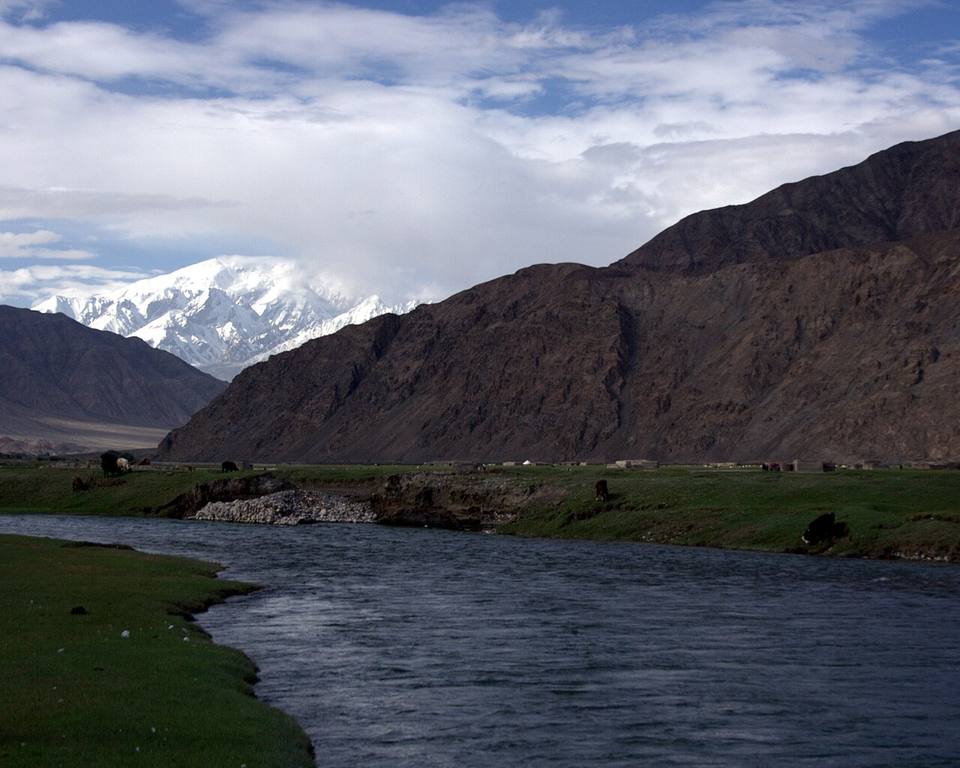
Chinese Mythology · Creation myth / sacred-mountain belief
Kunlun and the Queen Mother of the West
The Chinese way of imagining the roof of the world was to set upon the summit of Kunlun a queen who held the elixir of immortality.
Stories and legends
Kunlun is the ancestor of all the mountains under heaven. The Classic of Mountains and Seas (山海经) · Classic of Western Mountains (西山经) calls the Hill of Kunlun "the capital of the Emperor below, watched over by the god Luwu"; the mountain has nine gates, guarded by the Kaiming Beast, and from it flow four rivers — the River Water, the Red Water, the Green Water, and the Black Water — and mortals may not ascend it lightly. On the summit dwells the Queen Mother of the West (Xi Wangmu). Her earliest image is anything but kindly: the Third Classic of the West (西次三经) describes her with "a leopard's tail and tiger's teeth, fond of whistling, hair dishevelled and wearing a sheng headdress" — a deity of punishment who governed heaven's calamities and the five mutilating penalties, dwelling in a cave beside Jade Mountain. Only later did she gradually become a stately queen. Her most moving encounter comes in the Biography of King Mu, Son of Heaven (穆天子传): King Mu of Zhou drove his eight steeds westward and feasted and exchanged songs with the Queen Mother on the shores of the Jade Pool (Yaochi). The Queen Mother sang: "White clouds are in the sky, the mountains rise of themselves; the road is long and far, with mountains and rivers between; may you not die, and may you come again." King Mu answered that he would surely return within three years — yet in the end he never came back. It is the earliest longing in Chinese literature for a "love between god and mortal that could not be." By the Han dynasty, the Queen Mother sat paired with the King Father of the East (Dongwanggong) and became linked with Chang'e's elixir of immortality; the Huainanzi (淮南子) tells how Yi begged the elixir from the Queen Mother and Heng'e (Chang'e) stole it and flew to the moon. Later still, Daoism honoured her as chief of all female immortals, while folk belief had her meet the Cowherd across the Milky Way on the seventh day of the seventh month and host the other immortals at the Peach Banquet. Upon this single Mount Kunlun are layered the mountain-and-river gods of the pre-Qin age, the Han dynasty's dream of immortality, and the festival joys of later centuries.
Origins of the story
The textual layering is clear: the Classic of Mountains and Seas, compiled from the Warring States period through the Han, records Kunlun as a sacred mountain; the Queen Mother's image evolved from a half-bestial punishment deity into a mother goddess and queen, and by the Han dynasty her portraits on tomb stones already pair her with the King Father of the East. Kunlun's real-world correspondence was "fixed" after Emperor Wu of Han sent Zhang Qian west, when it was identified as the mountain at the source of the Yellow River; from the Qing onward it gradually merged with today's Kunlun range, but scholars generally hold that the mythic Kunlun is an ideal mountain compounded of several sacred peaks and should not be pinned to a single coordinate. The claim that the Queen Mother legend of Tianchi (Heavenly Lake) in the Tianshan Mountains of Xinjiang was entered into a national intangible cultural heritage list in 2024 appears in local culture-and-tourism reporting (a claim submitted for listing; the Ministry of Culture and Tourism's official list prevails).
Customs
On the plateau stretches, avoid running and shouting, and do not litter or pollute the waters of sacred lakes and mountains; at Tianchi, do not feed the animals and do not enter the water; when entering a Temple of the Queen Mother, follow local custom in offering incense and do not burn oversized incense sticks; ask permission before photographing herders and prayer flags; the weather at the pass changes suddenly, so bring warm clothing and altitude-sickness medicine.
Places you can visit
The Kunlun Pass in Qinghai (about 4,700 m above sea level, with the Kunlun Mountain stele and the Sonam Dargye memorial stele beside the Qinghai–Tibet Highway, and a distant view of Yuzhu Peak); Kunlun-themed cultural venues and Kunlun Park in Golmud; Tianchi (Heavenly Lake) in Fukang, Xinjiang (known in antiquity as Yaochi, the Jade Pool, with a Temple of the Queen Mother on its shore and the reflection of Bogda Peak in its waters); Zhangye and Wuwei along the Hexi Corridor in Gansu, corridor points in the narrative of King Mu's western journey. Temples such as the various Palaces of the Queen Mother are mostly sites chosen by local association; when visiting, understand them as "legendary sites." Performances such as the Peach Banquet are as officially announced each year.
Image source · Preston Rhea · CC BY-SA 2.0

