
Chinese Mythology · Creation myth
Nüwa Mends the Sky and Fuxi Draws the Trigrams
When the sky fell, she smelted stones to patch it; when humankind was ignorant, he gazed up at the heavens and drew the first trigram — this brother-and-sister pair (or husband and wife) are Chinese civilisation's "mender" and "lawgiver."
Stories and legends
Gonggong, in a rage, butted Mount Buzhou (the Huainanzi tells one version in which Gonggong contended with Zhuanxu for the emperorship): the pillar of heaven snapped and the cords of earth broke; the sky tilted to the northwest and the sun, moon, and stars shifted their places; the earth sank in the southeast and the rivers all flowed east; great fires raged and great floods would not recede; wild beasts devoured people and birds of prey snatched the old and weak. Nüwa, watching the humankind she had moulded from earth suffer, took five-coloured stones and smelted them to mend the sky, cut off the legs of a giant turtle to set up as the four poles, slew the black dragon, and heaped up reed ashes to stop the waters — and only then were heaven and earth at peace again. Yet the mended sky forever kept its scar — the northwestern sky always looks as if a corner were missing. Her other story with Fuxi took place beside Mount Kunlun: after a flood destroyed the world, only the brother and sister remained. Nüwa was ashamed to marry; on the mountain they lit two piles of smoke, and only when the smoke merged into one did they become husband and wife (one version says they rolled millstones together and their meeting was Heaven's will), and humankind multiplied once more. Fuxi, for his part, "looked up and contemplated the images in the heavens, looked down and contemplated the patterns on the earth, took from the body near at hand and from things far away," and drew the eight trigrams — Qian, Kun, Zhen, Xun, Kan, Li, Gen, Dui — and also knotted cords into nets, instituted the rites of marriage, and made written tallies. Mending the sky is disaster rescue; drawing the trigrams is institution-building: one repaired the world, the other explained it.
Origins of the story
Nüwa mending the sky first appears in complete form in the Huainanzi · Lanming Xun (览冥训); Fuxi drawing the trigrams appears in the Book of Changes (周易) · Xici Xia (系辞下): "Baoxi (Fuxi)… first made the eight trigrams." Images of the marriage of the siblings Nüwa and Fuxi appear on Han stone reliefs and on silk paintings from the Tang-dynasty Astana tombs in Turfan, Xinjiang. Huaiyang as the "ancient capital of Emperor Xi" and Tianshui as the "hometown of Emperor Xi" are both local historical narratives and sacrificial traditions; scholars regard Fuxi and Nüwa as mythical figures and do not treat them as verifiable historical persons. The Taihao Mausoleum temple fair has been entered into the national intangible cultural heritage list (temple-fair category), and the public sacrificial ceremony for Fuxi continues in Tianshui.
Customs
Temple fairs are crowded: do not push against the incense burners or walk against the flow of the worshipping procession; the "carrying scripture bundles" and "clay dogs" of the Taihao Mausoleum are local folk customs — when buying handmade goods, do not haggle insultingly in front of the stallholders; open fires and firecrackers are prohibited in the mausoleum area, per site notices; fortune-telling and divination are folk entertainment and should not be the basis for life decisions.
Places you can visit
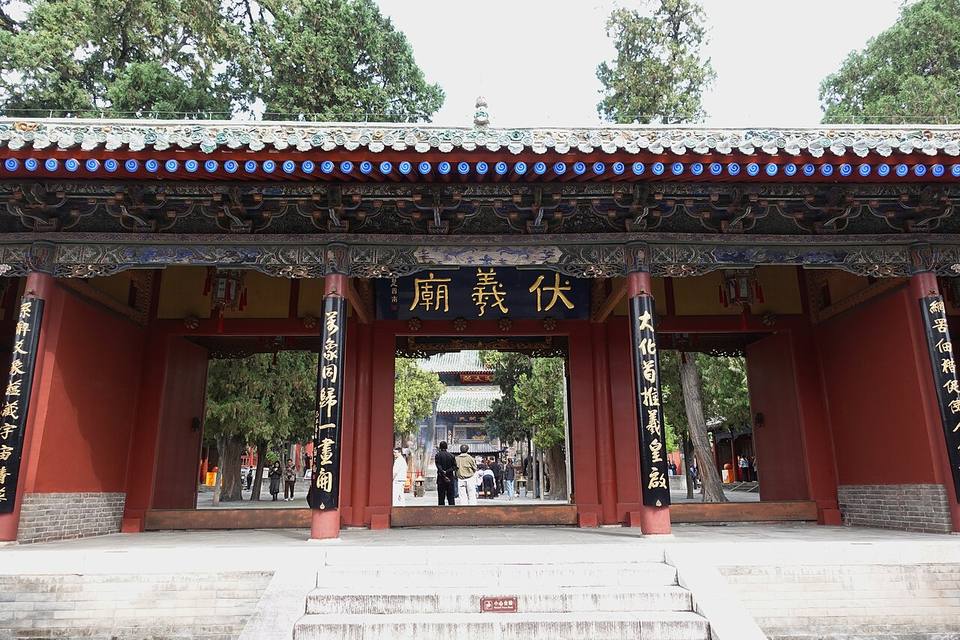
The Taihao Mausoleum in Huaiyang, Zhoukou, Henan (a combined mausoleum and temple; the temple fair runs from the 2nd day of the 2nd lunar month to the 3rd day of the 3rd month, as officially announced each year); Huaiyang's Dragon Lake and Xiange Terrace; the City of Nüwa in Xihua County (a site of local legend, dedicated to Nüwa, rebuilt repeatedly since the Ming and Qing); the Fuxi Temple in Tianshui, Gansu (first built in the Chenghua era of the Ming, a complex of ancient buildings) and the public sacrifice at Fuxi Square. The two places both claim to be the source — parallel sacrificial traditions, not an archaeological conclusion.
Image source · 颐园居 · CC BY-SA 4.0
