
Chinese Mythology · Classic of Mountains and Seas mythology / tales of strange beasts
Beasts of the Classic of Mountains and Seas: Zhulong, Taotie, the Nine-Tailed Fox, and Qiongqi
Four strange beasts governing day and night, greed, seduction, and right and wrong — it turns out the patterns on Chinese bronzes are all their portraits.
Stories and legends
On Mount Zhangwei beyond the northwestern seas, Zhulong the Torch Dragon opens his eyes and it is day, closes them and it is night; his breath out makes winter, his breath in makes summer; he neither eats nor sleeps nor rests, his body stretches a thousand li, and he carries a torch in his mouth to light the gates of the dark capital. The Taotie's entrance is more everyday: it has a sheep's body and a human face, eyes beneath its armpits, tiger's teeth and human claws, and a voice like a crying baby — its terror lies not in its ferocity but in its greed: it ate even its own body, which is why later generations called the beast-face on tripods and sacrificial vessels the "taotie pattern," and called those who eat without measure "old gluttons" (laotao). The nine-tailed fox lives in the land of Qingqiu; the Classic of Regions Beyond the Seas: East (海外东经) says only that it has "four legs and nine tails," and it was originally an auspicious omen. By the Han dynasty it had become a token of royal mandate — a white nine-tailed fox was even said to be a sign that King Wen had received Heaven's charge. But as the tales spread over time, it slid gradually toward the seductive fox spirit, and the legend of the Tushan clan together with later narratives of Daji saddled it with a thousand years of infamy. Qiongqi is the most inverted of all: in the Classic of Regions Within the Seas: North (海内北经) Qiongqi is shaped like a tiger and has wings, and eats people starting from the head; but the Qiongqi of the Classic of Spirits and Strange Things (神异经) bites the noses of good people and brings gifts to the wicked — the same beast, earnestly punishing evil in one book and aiding it in another, and the ancients themselves could not agree. An ending? Strange beasts have no endings. They walked from bamboo slips onto bronze tripods, and from bronze tripods into today's games and animation, and they have never left the stage.
Origins of the story
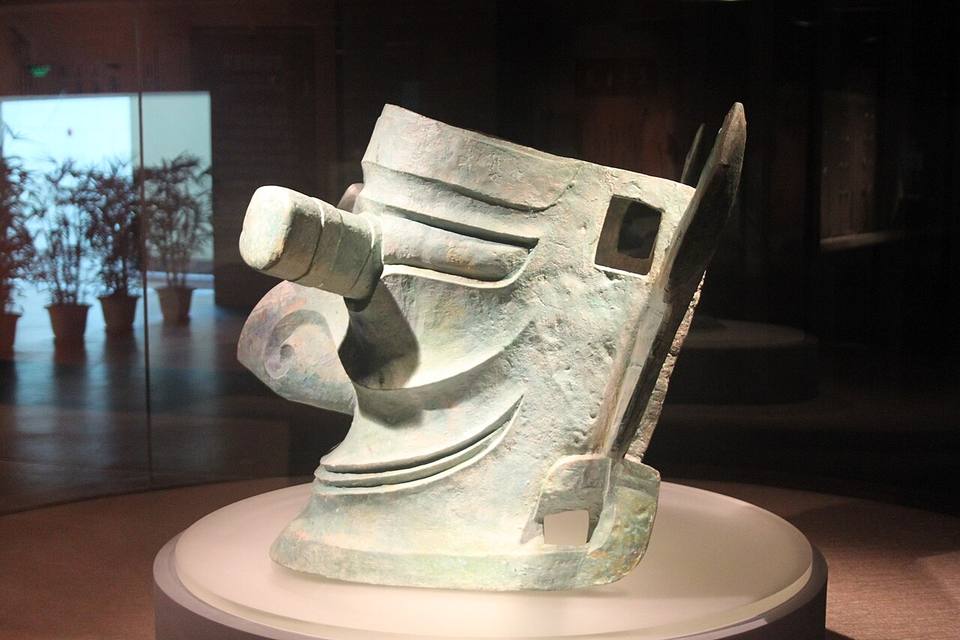
All four beasts appear in various chapters of the Classic of Mountains and Seas; the name Taotie is explained by the Lüshi Chunqiu (吕氏春秋) · Xianshi Lan (先识览): "The tripods of Zhou bear the taotie, which has a head but no body; it ate men but before it could swallow, the harm reached its own body." The nine-tailed fox's transformation from auspicious omen to seductive demon is the layered result of Han–Tang tales of the strange and Song–Yuan storytelling, and cannot be projected back onto the pre-Qin age. The Sanxingdui bronze mask with protruding pupils (137 cm wide, excavated in 1986 from sacrificial pit no. 2) is often associated with Cangcong, the ancient Shu king of the "protruding eyes" (one theory, with no direct inscriptional evidence); the correspondence between the beast-face patterns on Yinxu bronzes and the Taotie is a later naming, and scholars still debate whether it is in fact the Taotie.
Customs
Flash photography and touching the display cases are forbidden in the museums; Sanxingdui souvenir products of the "blessing" type are modern cultural-creative goods, not ancient Shu ritual implements — do not treat them as ancient rites; Yinxu is a burial site, so keep a respectful quiet when visiting and do not frolic or pose for playful photos in the sacrificial areas.
Places you can visit
The Sanxingdui Museum in Guanghan, Sichuan (the bronze mask with protruding pupils, the crowned protruding-pupil mask, the bronze sacred tree); the Yinxu Museum and the Yinxu site in Anyang, Henan (beast-face patterns on bronze tripods, objects from the tomb of Fu Hao); the permanent Shang and Zhou bronze exhibitions at the National Museum of China and the Henan Museum. Festivals depend on each museum's special-exhibition schedule, as officially announced each year.
Image source · Gary Todd from Xinzheng, China · CC0

