
Chinese Mythology · Folk tale
The Legend of the White Snake
A snake who had cultivated herself for a thousand years wanted only to be a mortal wife — yet the most stubborn monk in the human world insisted on enforcing "the Law" on Heaven's behalf.
Stories and legends
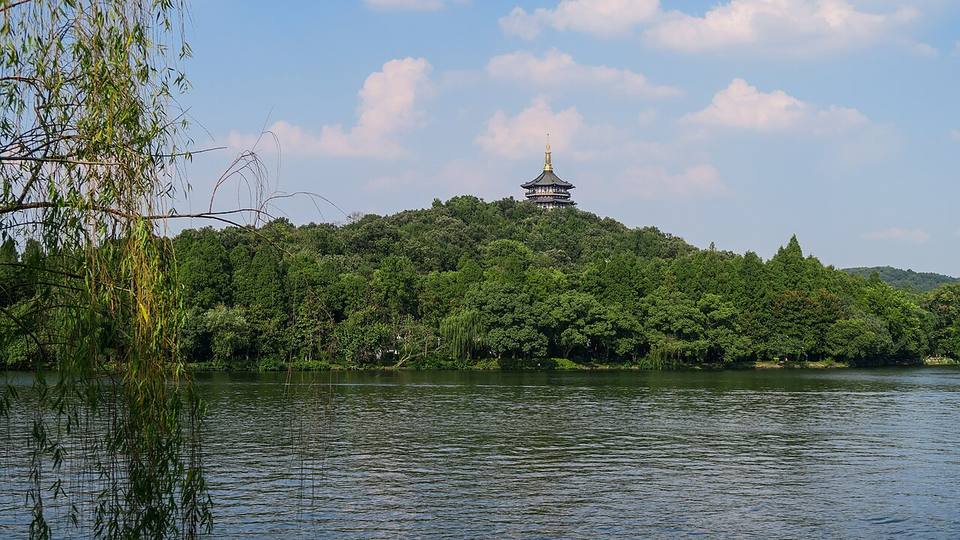
At Broken Bridge on West Lake, in the misty rain of Qingming. Bai Suzhen, a white snake who had cultivated herself for a thousand years on Mount Emei (in one version, Mount Qingcheng), in order to repay Xu Xian (also named Xu Xuan) for saving her life in a previous incarnation, took human form and, accompanied by the green snake Xiaoqing, met the apothecary's assistant Xu Xian on Broken Bridge by borrowing an umbrella, and married him. The couple opened the Baohetang pharmacy in Zhenjiang (in other versions, Suzhou or Hangzhou) and healed the world with their medicine. But Fahai, the eminent monk of Jinshan Temple, declared that Xu Xian was bewitched by a snake demon and gave him realgar wine for the Dragon Boat Festival (Duanwu); Bai Suzhen drank the wine and revealed her true form, and Xu Xian died of fright. Bai Suzhen risked her life to steal the numinous fungus herb of Kunlun and brought her husband back to life. Fahai then lured Xu Xian to Jinshan Temple and held him there; Bai Suzhen flooded Jinshan and battled Fahai with magic, but the floodwaters harmed innocent lives, and so she transgressed the law of Heaven. After she gave birth to a son, Fahai used his golden alms bowl to suppress her beneath Leifeng Pagoda on West Lake, leaving the prophecy: "When West Lake's waters dry, when the rivers no longer rise, when Leifeng Pagoda falls, the White Snake shall come forth again." Many years later her son Xu Shilin (also named Mengjiao) became the top scholar in the imperial examination and went to the pagoda to sacrifice to his mother; the pagoda crumbled, the clouds scattered, and mother and son were reunited (in the early storytellers' scripts the ending was bleaker — the White Snake was suppressed under the pagoda forever; the reunion ending is a rewriting by later opera). The love between human and demon lost to order, but won a thousand years of tears.
Origins of the story
The source lies in snake-wife horror tales of the Tang chuanqi tradition such as "Li Huang" in the Boyi Zhi (博异志); in the Song storytellers' script The Three Pagodas of West Lake (西湖三塔记) the White Snake is still a man-harming demon; Feng Menglong's "Madame White Snake Imprisoned Forever Under Leifeng Pagoda" in Stories to Caution the World (警世通言) fixed the framework, and Bai Suzhen's image first gained sympathy; Qing-dynasty tanci ballads and opera (Fang Chengpei's Leifeng Pagoda) completed the "pathos-isation." The "Legends of West Lake" were entered into the national intangible cultural heritage list in 2008. Leifeng Pagoda was built by Qian Chu, king of Wuyue (around 977), collapsed in 1924, and was protectively rebuilt on the original site in 2002 — it is not the original pagoda; the West Lake World Heritage nomination text lists the Legend of the White Snake as one of the intangible elements of the West Lake cultural landscape.
Customs
At the Leifeng Pagoda site, do not step on the glass covers of the pagoda-base ruins or throw coins into the ruins pit; at Jinshan Temple, worship in order and do not block the temple gate for wedding photography; realgar wine at Duanwu is an episode of the legend — in reality realgar is toxic: do not drink it and do not smear realgar on children (disease-control authorities in many places remind the public of this every year); releasing snakes at West Lake is illegal and damages the ecology — "releasing white snakes" in the name of charity is strictly forbidden.
Places you can visit
Broken Bridge and Leifeng Pagoda on West Lake in Hangzhou (inside the new pagoda are Dongyang wood carvings of The Legend of the White Snake, and the old pagoda's underground palace ruins are displayed at the base), the West Lake Museum; Jinshan Temple in Zhenjiang (Jiangtian Chan Temple, with the Cishou Pagoda, the White Dragon Cave, and other associated spots) and the Jinshan Lake area; regular performances of The Legend of the White Snake at opera venues in Suzhou, Shaoxing, and elsewhere. Performance schedules are as officially announced each year.
Image source · Yinweichen · CC BY-SA 4.0
