
Kyushu · Shrine / Ancient faith
Kirishima Shrine
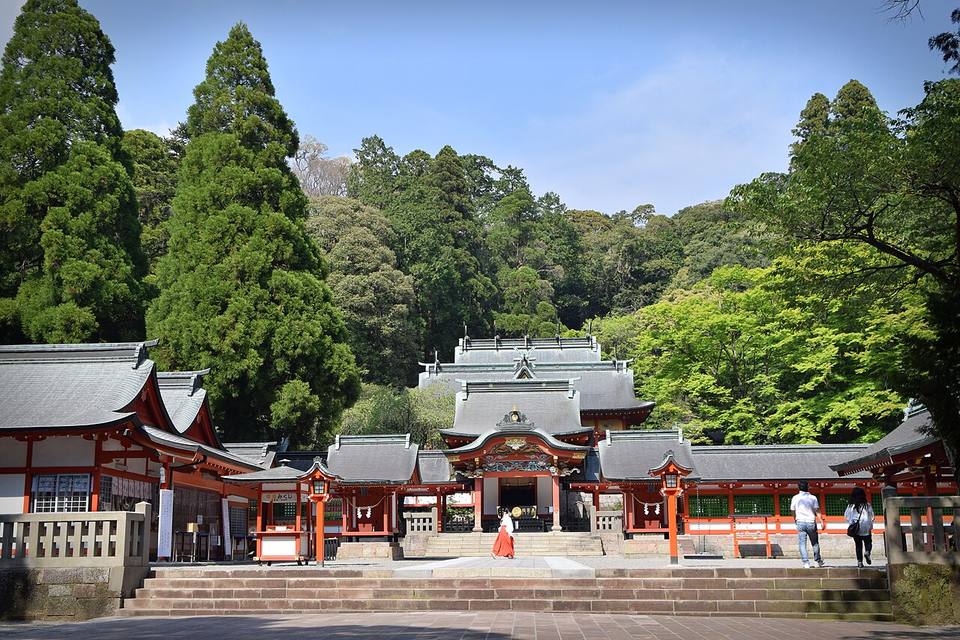
A vermilion shrine hall set into the Kirishima cedar forest, enshrining Ninigi-no-mikoto, protagonist of the descent myth — this is the mountain where the "Tenson kōrin" (descent of the heavenly grandson) myth touches the ground.
Location
Kirishima City, Kagoshima Prefecture
Stories and legends
The Tenson kōrin myth of the Kojiki (《古事记》) and Nihon Shoki (《日本书纪》): Ninigi-no-mikoto (瓊瓊杵尊) descended, by command of Amaterasu, to Mount Takachiho in Kyushu — myth, not historical fact.
History and context
Kirishima faith is an old ground of mountain asceticism; the shrine's founding is traditionally dated to the 6th century, in the reign of Emperor Kinmei, at the foot of Mount Takachiho. The present hall was rebuilt in 1715 as an offering by Shimazu Yoshitaka, lord of Satsuma — lacquered vermilion with painted decoration and designated an Important Cultural Property. Highlights include the roughly 800-year-old sacred giant cedar (御神木) and the kagura tradition of the Kagura Hall.
Local life
The Kirishima area is where myth and hot springs overlap: the shrine approach is deep in cedar shade, and mist often curls around the very name "Kirishima" (Mist Island); after worship, going down the mountain to soak in the Kirishima onsen town is the classic Satsuma day out. In kagura season (around the annual festival on November 9), local parishioners dance the kagura — here myth is not an exhibit board but a living calendar.
Customs
The grand festival and Kirishima kagura are the year's core; worship follows the Shinto standard of two bows, two claps, one bow.
Beliefs
Shinto; the enshrined deities are seven pillars headed by Ninigi-no-mikoto, integrated with the Mount Takachiho mountain faith.
Local etiquette
The center of the approach (正中, seichū) is the gods' path — walk at the sides; confirm permission before photographing kagura or festivals; do not enter the fence around the sacred tree or touch its trunk.
Visiting notes
Best in November for autumn leaves and the annual festival period, and in spring for fresh green; the early morning has the fewest worshippers and the thickest mist; combine with the Kirishima onsen town and Maruo Falls on one line in a day.
What to eat nearby
Black pork dishes; Kirishima tea (霧島茶) and tea sweets; Satsuma shochu; mountain-vegetable soba; onsen steamed eggs
The ryokan street of the Kirishima onsen town, around Kirishima-Jingu Station, teahouses on the approach
Teahouses are mostly cash-only; restaurants near the shrine close early, so have dinner in the onsen town
Set meals 1,300–2,000 yen (about 61–94 yuan, for reference only)
Buses run up the mountain from JR Kirishima-Jingu Station but are infrequent — check the timetable first; the approach can frost over in winter, so guard against slipping.
Source leads: Kirishima Shrine official site, Kirishima City official tourism, Agency for Cultural Affairs Important Cultural Property materials.
Image source · Raita Futo from Tokyo, Japan · CC BY 2.0