
Kyushu · Hot spring / natural wonder
Beppu Jigoku Meguri (Hells Tour)
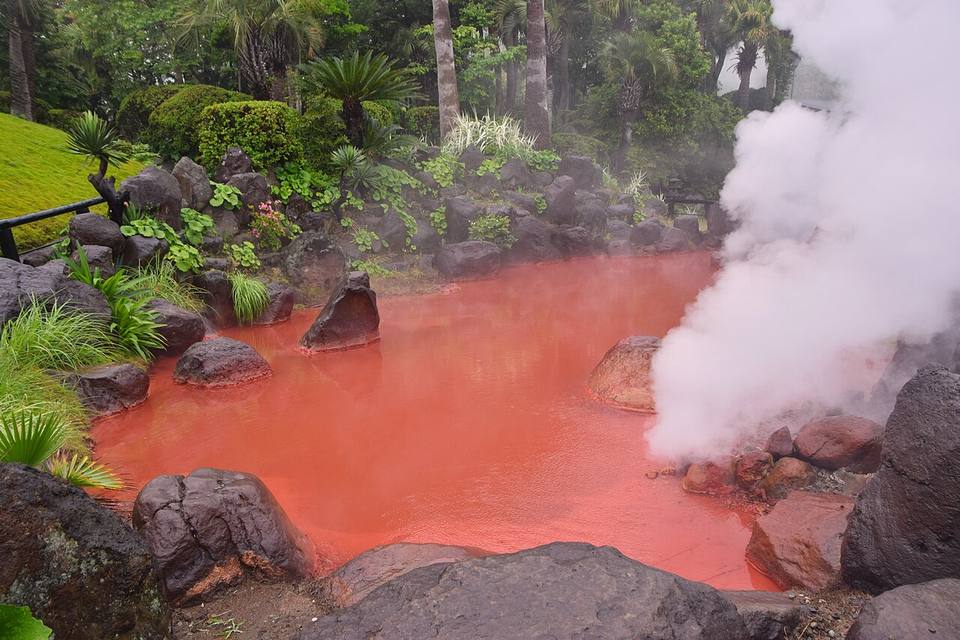
Seven geothermal wonders you cannot bathe in, only look at — the cobalt-blue Umi Jigoku and the blood-red Chinoike Jigoku, with spring temperatures mostly above 90°C; here the earth boils right in front of you.
Location
Beppu, Oita Prefecture
Stories and legends
The name "jigoku" (hell) is traditionally explained by people's fear of these steaming, hot-mud lands, which they took for gates to hell — a naming legend.
History and context
Beppu's spring output is among the largest in Japan; the hells are concentrated in the Kannawa and Kamegawa districts and formed over more than a thousand years. Umi Jigoku (Sea Hell) formed about 1,300 years ago in an eruption of Mount Tsurumi; its water is about 98°C and cobalt blue from iron sulfate. Chinoike Jigoku (Blood Pond Hell) is reddish from iron oxide and one of Japan's oldest hells (Nara-period documents are said to record a red hot spring). A combined ticket touring all seven hells is the standard route; there are also Oniishibozu Jigoku (gray mud boiling like a monk's head) and Oniyama Jigoku (crocodiles raised with geothermal heat).
Local life
Beppu is a city where "hot springs are daily life": steam rises from manhole covers and behind houses, grandmothers steam food with onsen steam (the Jigoku Mushi workshop is right in Kannawa), and bamboo craftwork and yunohana thatched huts form its artisan base. The hells tour looks touristy, but each hell is actually a source of the hot-spring supply system — tourism and daily life share the same origin.
Customs
After the tour, the full local experience is a "mushiyu" steam bath and a foot bath in Kannawa; hell-steamed eggs are eaten as you walk.
Beliefs
The naming relates to the Buddhist view of hell; overall, its main cultural identity is geothermal science display and onsen livelihood culture.
Local etiquette
Beyond the rails at the hell pools is a high-temperature zone — never climb over or reach in to test the water; many areas ban drones; do not knock on the glass to provoke the crocodiles; steam fogs camera lenses — wipe with a proper lens cloth, nothing rougher.
Visiting notes
Good in all seasons; steam volume is greatest and most spectacular in winter; the combined ticket takes about 2–3 hours to complete — go in the first hour after opening and start with Umi Jigoku (the bluest light); staying a night in Kannawa to hop between communal baths is the deep way to play.
What to eat nearby
Hell-steamed cooking (地獄蒸し, seafood and vegetables steamed with onsen steam); Beppu reimen (別府冷麺, thick, chewy noodles, a local noodle school); seki-aji / seki-saba sashimi (関あじ・関さば, brand fish from the Bungo Channel, seasonal); ryukyu-don (りゅうきゅう, marinated sashimi over rice, chazuke-style); onsen pudding
Around the Jigoku Mushi workshop in the Kannawa onsen street, the shopping street in front of Beppu Station, the dining area around Beppu Tower
Seki-saba and seki-aji are expensive fish — confirm the market price when ordering; the hell-steaming workshop is self-service steaming — manage your own timing, and use gloves, as the steam baskets are scalding
Hell-steamed sets 1,500–2,800 yen (about 70–132 yuan, for reference only); reimen 900–1,200 yen (about 42–56 yuan, for reference only)
The seven-hells combined ticket is better value than buying singly (prices per the official site); a tour-bus pass suits those without a car.
Image source · Raita Futo from Tokyo, Japan · CC BY 2.0