
Kyushu · Natural wonder / Active volcano
Mount Aso Nakadake Crater
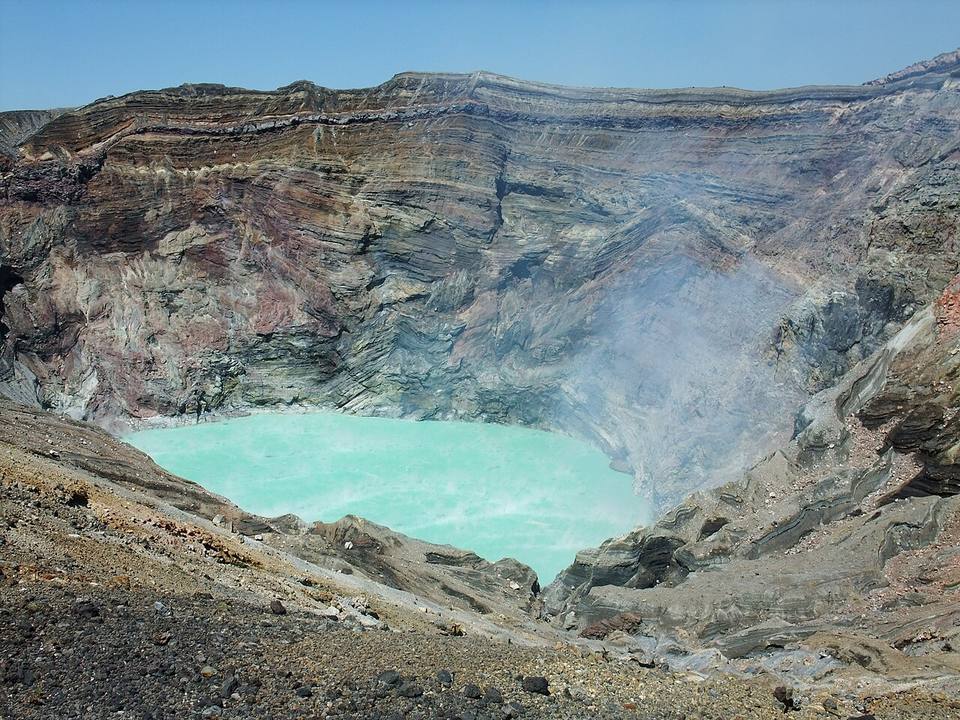
Stand at the center of a world-class caldera and watch an emerald acidic crater lake churn below your feet — Aso is one of the few volcanoes where you can see an active crater up close.
Location
Aso City, Kumamoto Prefecture
Stories and legends
Aso mythology tells of Takeiwatatsu-no-mikoto developing Aso, kicking open the lake water to create fields — a mythic narrative.
History and context
The Aso caldera formed in a huge eruption about 90,000 years ago, about 25 kilometers north-south and 18 kilometers east-west, with about 50,000 people living inside it (a rare in-caldera town cluster worldwide); Nakadake is still active, and its crater lake is turquoise from strong acidity. Crater access is controlled by volcanic gas concentrations; eruptions in 2014, 2016, and other years closed it for long periods, and the 2016 Kumamoto earthquakes badly damaged the mountain trails and ropeway (the Aso summit ropeway was abolished after the quake and replaced by shuttle buses).
Local life
Life in Aso is "dwelling with eruptions": cattle grazing at Kusasenri, volcanic-ash farmland, and the shrine's fire-swinging rituals form a volcano-coexistence folklore. The grasslands are maintained by a thousand years of "noyaki" spring grass-burning; on burn day the whole mountain smokes — one of Japan's largest grassland-management rituals. Visitors smelling sulfur at the crater and watching the warning lights come to understand exactly this scale of coexistence.
Customs
The spring noyaki (usually March) is an important farming and scenic event, to be watched from designated areas; the Aso Shrine fire-swinging rite (Hifuri Shinji) is a famous spring festival.
Beliefs
Aso Shrine (the head shrine of all Aso shrines nationwide) enshrines Takeiwatatsu-no-mikoto, and mountain faith is strong; the volcano itself is a sacred body.
Local etiquette
Crater controls follow the day's gas readings — if the red light or broadcast evacuation sounds, leave immediately; people with asthma or respiratory conditions should not approach the crater; do not cross the fences; never discard cigarette butts in the grasslands (fire is strictly forbidden outside the noyaki).
Visiting notes
On the day you go, always check the official Aso volcano disaster-prevention opening status; best on clear spring and autumn mornings (good gas dispersion, low closure probability); to avoid crowds, choose early morning at Kusasenri and the Aso-san-nishi station line; summit weather changes suddenly — a windproof layer is essential.
What to eat nearby
Akaushi rice bowl (あか牛丼, Aso brown-haired wagyu); takana rice and dago-jiru dumpling soup (だご汁, Kumamoto hometown food); horse-meat dishes (a Kumamoto specialty — use proper shops); Aso milk and ice cream; vegetables from volcanic-ash farmland
Around Aso Station, the Uchinomaki onsen street, the Kusasenri restaurant area
Famous akaushi-bowl shops hand out queue numbers and stop when sold out; confirm the cut when ordering horse meat
Akaushi rice bowl 1,800–2,800 yen (about 85–132 yuan, for reference only)
On crater-closure days, a route of Kusasenri + Aso Shrine + Daikanbo is not a wasted trip; when driving, beware slippery volcanic-ash road sections in the rain.
Source leads: Aso City official tourism, Japan Meteorological Agency Mount Aso volcanic information, Aso Volcano Museum / Mount Aso summit official guidance.
Image source · Igorberger · CC BY-SA 3.0