
Hokkaido · Hot spring / natural wonder
Noboribetsu Onsen and Jigokudani (Hell Valley)
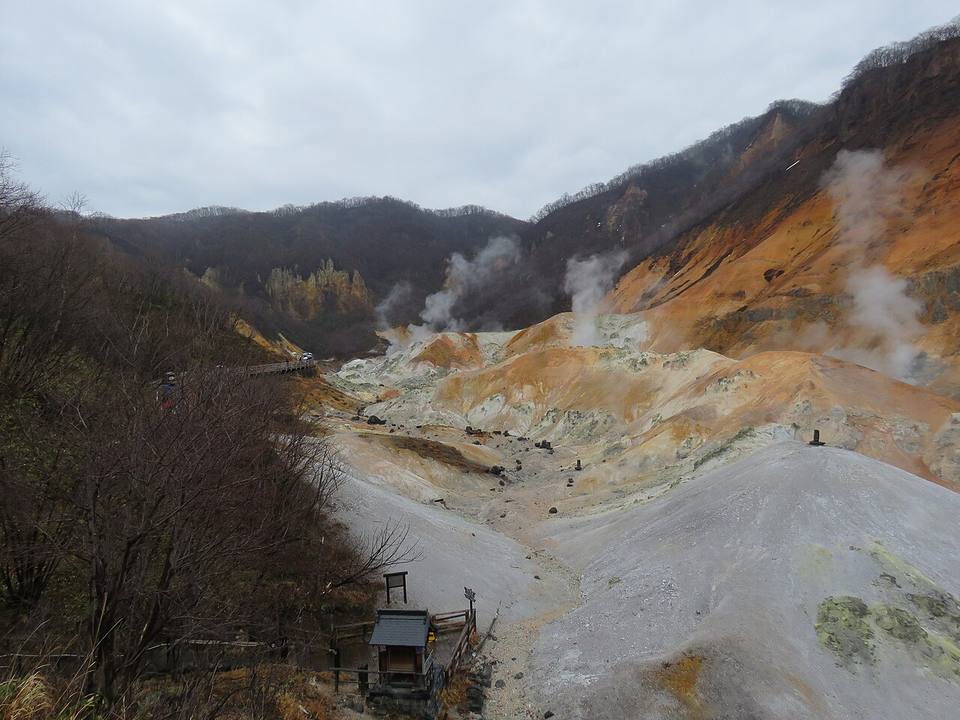
The Jigokudani crater left by a volcanic eruption about 10,000 years ago still pours out a huge volume of hot-spring water every day, supplying the whole onsen town with nine different spring qualities.
Location
Noboribetsu, Hokkaido
Stories and legends
The name Jigokudani (Hell Valley) comes from its sulfurous fumes and boiling mud, like a Buddhist painting of hell; folklore tells of a hot-spring demon deity, the "Yu-kijin," and friendly demon statues stand at Noboribetsu Station and around the onsen town, born of imaginings of warding off illness and praying for blessings.
History and context
Jigokudani is the remnant of an explosion crater from Mount Hiyori, about 450 meters in diameter; people were already coming here to heal wounds in the Edo period — legend says samurai treated battle injuries here — and after the Meiji era it was developed into a hot-spring resort. At Oyunuma and Okunoyu you can still see gray sulfur mud boiling. Noboribetsu has as many as nine spring qualities (sulfur, salt, iron, radium, and more), earning it the nickname "hot-spring department store."
Local life
Noboribetsu has the grandeur of Hokkaido's number-one onsen town: long-established ryokan line Gokuraku-dori, and fumaroles and demon-doll performances give it the lively base note of a Shōwa-era onsen street; walk ten minutes into the hills, though, and only the smell of sulfur and the sound of steam remain — the contrast between bustle and stillness is huge. Locals tell the story that "the demons of Jigokudani are guardians, not evil spirits" — the demon statues mostly have endearing expressions, and they are even dressed up during festivals.
Customs
At the summer Noboribetsu Jigoku (Hell) Festival, demon mikoshi (portable shrines) parade through town; for bathing, wash first, then soak (see feature essay J1 for details).
Beliefs
Related to the Buddhist view of hell and folk demon beliefs; the onsen town bears traces of healing faiths such as Yakushi Nyorai (the Medicine Buddha), but overall it belongs to folk belief rather than a single religious site.
Local etiquette
Areas off the Jigokudani boardwalk are high-temperature danger zones — never step off the path onto the surface (hot mud lies right beneath the thin crust); sulfur springs tarnish silver jewelry, so remove it before bathing; do not soak for long in strongly acidic springs.
Visiting notes
Good in all seasons; autumn colors and winter snow-with-steam photograph best; before 7:00 Jigokudani is almost empty; staying in the onsen town lets you walk there and back, avoiding the day-trip traffic peak (11:00–15:00).
What to eat nearby
Hell-steamed onsen eggs (温泉たまご); Noboribetsu Enma yakisoba (登別閻魔やきそば, spicy fried noodles, a local B-class gourmet dish); seafood rice bowls (seafood from Noboribetsu's nearby waters); milk pudding / ice cream (登別酪農, Noboribetsu dairy); demon-face manju and other souvenir sweets
The Gokuraku-dori shopping street, ryokan kaiseki meals in the onsen town, diners around Noboribetsu Station
Enma yakisoba comes in graded spice levels — confirm the heat when ordering; onsen eggs are mostly eaten standing at stalls, so take your trash with you
Set meals 1,200–2,000 yen (about 56–94 yuan, for reference only); ryokan with two meals from 15,000 yen (from about 705 yuan, for reference only)
For a day-trip bath, choose a ryokan whose large bath offers many spring qualities for the best value; clothes pick up the sulfur smell and need washing, so bring a sealed bag.
Source leads: Noboribetsu City official tourism association, Noboribetsu Jigokudani official introduction, JNTO Noboribetsu page.
Image source · Calistemon · CC BY-SA 4.0