
Japanese Mythology · Creation myth / solar myth
Amaterasu and the Rock Cave of Heaven
The sun goddess, sulking, hid in a rock cave and the world fell into darkness; the gods used laughter and a dance to trick the light back out.
Stories and legends
Susanoo ran wild in Takamagahara: he broke down the ridges between the rice paddies, fouled the palace, and finally flayed a heavenly piebald horse and hurled it into the weaving hall, frightening a weaving maiden to death. Amaterasu Ōmikami, startled and enraged, hid herself in the Amano-Iwato (Rock Cave of Heaven) and shut the stone door fast — Takamagahara and the Central Land of Reed Plains fell at once into endless night, the myriad gods grieved, and all evils ran rampant. The eight million gods gathered by the Yasugawara riverbank to confer: the god Omoikane devised a plan, and Ama-no-Uzume stood upon an upturned wooden tub and danced a dance both comic and fervent, baring her breast and laughing aloud, until the assembled gods roared with laughter and the sound shook Takamagahara. Inside the cave, Amaterasu grew suspicious: "After my withdrawal the world should be filled with weeping — whence this laughter?" She quietly pushed the stone door ajar and asked; Uzume answered, "A god more noble than you has arrived," and held out the Yata Mirror — Amaterasu leaned close to look at the "noble god" in the mirror (in fact her own reflection), and the god Tajikarao seized her hand and pulled her out of the cave, while Futodama quickly stretched a shimenawa rope across the entrance, declaring "you shall not enter again." Light returned to the earth, and Susanoo was expelled from Takamagahara. Dance and laughter defeating darkness — this is the mythic birth certificate of Japanese performing arts (kagura).
Origins of the story
Found in the upper volume of the Kojiki and volume 1 of the Nihon Shoki; variant texts in the Nihon Shoki differ slightly in the details of the dance and the accounts of the mirror and the jewels. The "original site" of the Amano-Iwato cannot be verified: the faith at Takachiho in Miyazaki took shape from the medieval period onward in local shrine tradition, while Ise Jingū is the national cult centre of Amaterasu (with the shikinen sengū rebuilding system) — the two places divide the roles of "legendary stage" and "cult orthodoxy." Takachiho Yokagura (night kagura) was designated an Important Intangible Folk Cultural Property in 1978.
Customs
The stacked stones at Amano Yasugawara are other people's prayers — do not knock them down, and do not pile them into playful shapes and leave them (even stacking and gently returning them is debated; simply add one stone gently, following the crowd); during kagura performances, no flash photography and no loud commentary in the middle — it is a sacred rite, not a stage show; at Ise Jingū, follow its formal rules in details such as not photographing the main sanctuary and keeping to the right when crossing the shrine bridges; strictly observe the no-photography zones at the cave worship site of Amano-Iwato Shrine.
Places you can visit
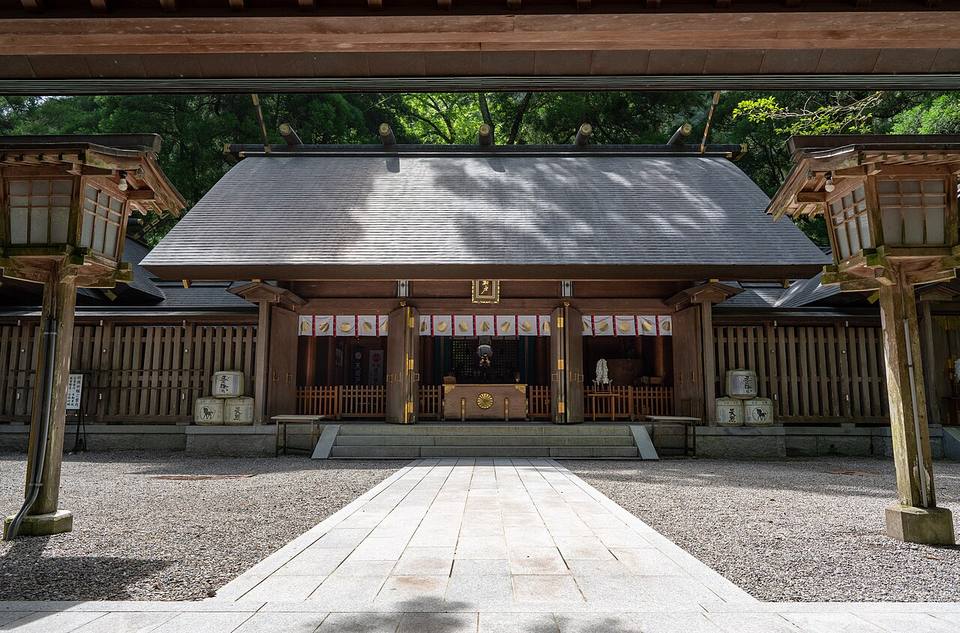
Amano-Iwato Shrine in Takachiho Town, Miyazaki Prefecture (the Western Main Shrine's distant-worship site of the cave, the wish-stone towers at Amano Yasugawara); Takachiho Gorge; the selected four dances of "Takachiho Kagura" performed nightly at the Kagura hall of Takachiho Shrine (about one hour; admission for reference only, as announced by the shrine); the full 33-dance night kagura is performed through the night in rotation among the settlements, usually from mid-November to early February the following year, as officially announced each year. The Inner Shrine (Naikū) of Ise Jingū in Mie (whose main deity is Amaterasu Ōmikami) is an extended pilgrimage point.
Image source · Big Ben in Japan · CC BY-SA 2.0


