
Japanese Mythology · Tales of yōkai / warrior-house legend
The Tengu of Mount Kurama and Minamoto no Yoshitsune
The orphaned young lord of a fallen house, fostered at an ancient mountain temple, learned swordsmanship from a tengu night after night — later he became Japan's most tragic famous general, Minamoto no Yoshitsune.
Stories and legends
After the Heiji Rebellion, Taira no Kiyomori spared the life of Ushiwakamaru, the young son of Minamoto no Yoshitomo, and fostered him at Kurama-dera in the northern mountains of Kyoto, hoping he would take the tonsure and end his life as a monk. The boy Ushiwakamaru refused to accept his fate: by day he chanted sutras in the temple; by night he slipped into the dense forest of Sōjōgatani valley. Legend says the valley was home to the great tengu Sōjōbō — red-faced and long-nosed, with wings on his back, the highest lord of Mount Kurama (in one account, an attendant of the mountain temple's honzon, the Demon King). The tengu saw the boy's obstinacy and his natural frame, and night after night taught him strategy and swordsmanship: Ushiwakamaru leapt and darted over fallen trees and practised his footwork among the coiling roots of the "path of tree roots" (Kinone-michi), light as a bird. On the day his training was complete, he vaulted over the railing of Gojō Bridge before the thousand-man slayer Musashibō Benkei and defeated him with a fan — but that is a later story. In the Kurama narrative, the tengu is no man-eating demon but the "teacher in the mountains," the only one in a chaotic age willing to teach skill to someone with neither power nor influence. Ushiwakamaru later passed through Kibune and Hiraizumi and came of age as Minamoto no Yoshitsune; his master-and-pupil bond with the tengu became the boyhood chapter retold again and again by the Noh play Kurama Tengu and countless period dramas. The sorrow of the ending lies outside the mountain: Yoshitsune, his merit too great, was hunted down by his elder brother Yoritomo and died at last in Hiraizumi — and so the dense forest of Kurama remains forever at the moment before anything had happened.
Origins of the story
Yoshitsune's fostering at Kurama-dera is narrated in the Tale of the Heike (平家物语) tradition; the tengu's teaching of his art took shape mainly in the Gikeiki (义经记) (a Muromachi military chronicle) and in Noh and jōruri — a layer of later legend; the official history Azuma Kagami has no tengu affair. Kurama-dera was founded at the end of the Nara to the beginning of the Heian period (traditionally by Gantei in 770); its honzon is now the three-in-one body of Bishamonten, Senju Kannon, and the Guardian Demon King. The great tengu statue in front of Kurama Station was installed by local people in 1994 to commemorate the 1,200th anniversary of the transfer of the capital to Heian (the second-generation statue); it is not an antique.
Customs
On the day of the Fire Festival the streets of Kurama are extremely crowded — follow the one-way flow and police guidance, do not stand directly beneath the torches, and carry no flammables; the mountain paths are practitioners' ways — do not make noise, and do not step on the tree roots of the Kinone-michi to take photos; the water divination at Kifune Shrine must use the shrine's divination paper — do not put ordinary paper into the water basin; many stretches of the mountain have no signal, so do not walk alone at night "looking for tengu."
Places you can visit
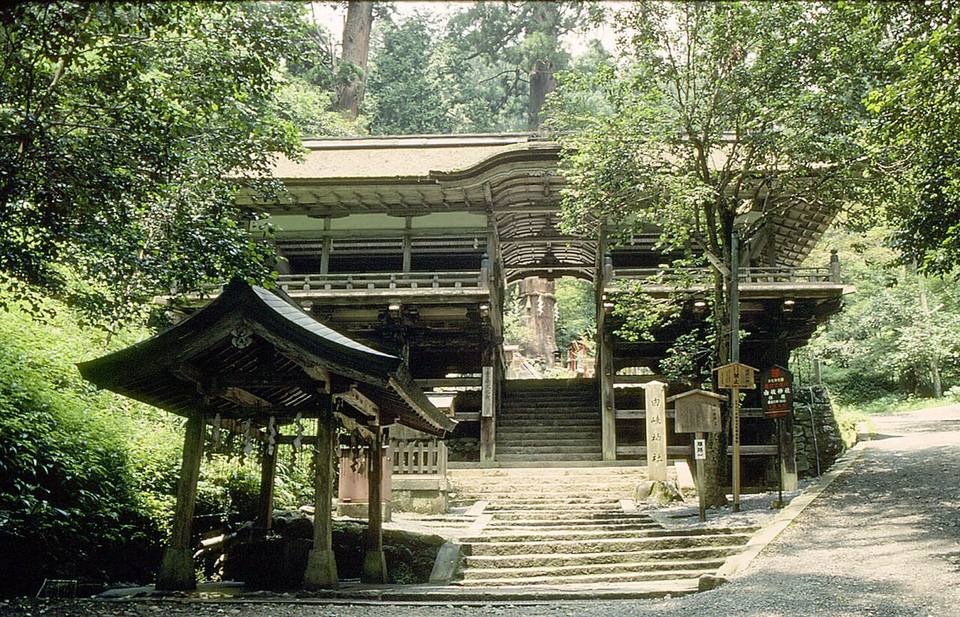
Kurama-dera in Sakyō Ward, Kyoto (the Niōmon gate, the main hall Kondō, the inner sanctuary Maōden, the Kinone-michi path of tree roots, and legend sites associated with Yoshitsune such as the Ikitsugi water and the back-comparing stone); Yuki Shrine (a site of Izumi Shikibu's retreat in the Tale of Genji tradition, and water-deity worship); Kifune Shrine (the legend of the origin of ema votive plaques at the shrine of bonds); the Kurama Fire Festival at Yuki Shrine (usually on the night of 22 October, when torch processions march with the calls of "Saireya, Sairyō," as officially announced each year, with strict crowd control).
Image source · · Public domain
