
Japanese Mythology · Folk tale / sea faith
Urashima Tarō and the Dragon Palace
Three days beneath the sea, three hundred years in the human world — and the jade casket he brought back, which he must never open, held his own youth.
Stories and legends
The fisherman Urashima Tarō of Tango (in other versions, Hyūga and elsewhere; versions differ by region) rescued a sea turtle being bullied by children. The next day a great turtle surfaced on the sea to thank him: the little turtle was the form taken by Otohime, princess of the Dragon Palace, who invited him to visit it. Tarō rode the turtle into the sea: at the Dragon Palace the pillars were coral and sea bream and flounder stood in rows, and each of its four gates showed the scenery of one season; Otohime entertained him with feasts, and the music and dancing never ceased. Tarō thought of his old mother and after three days (in one version, some months) asked to leave. Otohime gave him a jewelled casket, urging him: whatever happens, do not open it; it will keep you safe. Tarō returned to his home village, but the house was gone and his family all dead; a passer-by checked the family registers and found that "three hundred years ago there was an Urashima Tarō who went to sea and never returned." In despair he opened the casket: a wisp of white smoke rose, and in an instant Tarō's hair and beard were white and his back bent — sealed in the casket were precisely the three hundred years of his life that he had spent in the Dragon Palace. In the oldest version, a fragment of the Tango no Kuni Fudoki (丹后国风土记), the hero is called Mizunoe no Urashima no Ko, and after returning home he opens the casket and his soul drifts away into the sky (the old text is terse and accounts differ); the medieval Otogi-zōshi version says he finally became an immortal crane and kept company with Otohime, who became a turtle, at Hōrai (the crane-and-turtle consolatory ending). The differences between versions are themselves the most honest part of this story: people always want to rewrite that ending of no return.
Origins of the story
The oldest stratum is seen in the 8th-century Nihon Shoki (the entry on Mizunoe no Urashima no Ko), in poems of the Man'yōshū (万叶集), and in the fragmentary Tango no Kuni Fudoki; the name "Tarō" and the details of the jewelled casket were fixed in the medieval otogi-zōshi. Urashima Shrine (Ura Shrine) in Ine is said by shrine tradition to have been founded in 825 and to hold old documents narrating Urashima no Ko's homecoming (the shrine's own transmitted account); the claim of the Ryūgū Shrine at Nagasakibana in Ibusuki, Kagoshima, as the "place of departure" is a local legend. The two places' narratives are not mutually exclusive to the point where truth can be adjudicated; both are presented as legendary sites.
Customs
After worshipping at a seaside shrine, do not linger in the reef zone to watch the tide — the wind and waves are strong around Ryūgū Shrine; do not feed or chase sea turtles (most Japanese sea turtles are protected animals, and on egg-laying beaches lights and noise are forbidden at night); the casket-shaped omamori are bestowed articles — do not take apart someone else's omamori in public "to look at the years."
Places you can visit
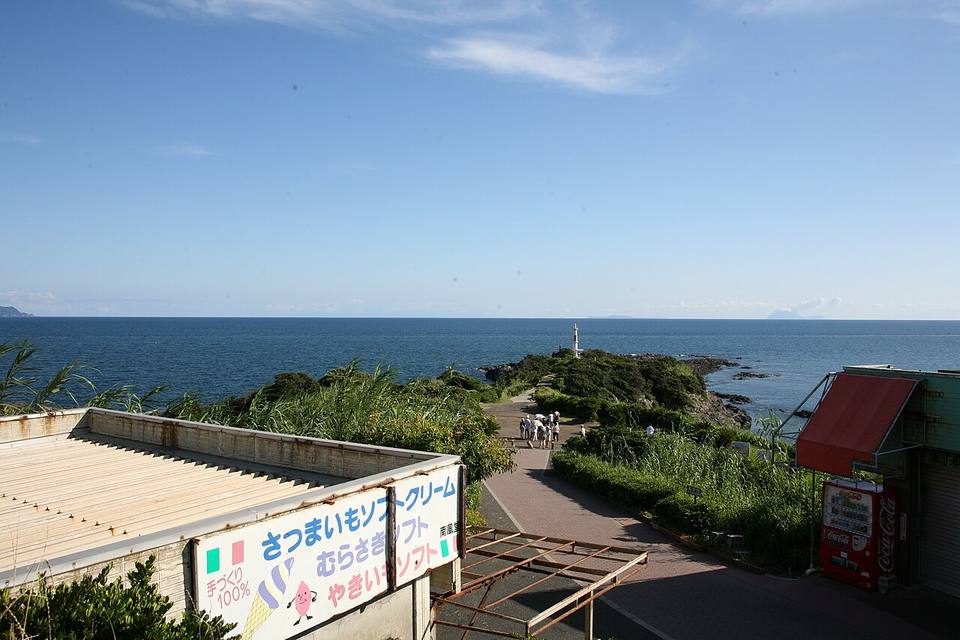
Urashima Shrine (Ura Shrine) in Ine Town, Tango, Kyoto (at Honjōhama; the Ine boathouses can be toured together); Ryūgū Shrine in Ibusuki City, Kagoshima (below the Nagasakibana lighthouse, with statues of Urashima and the turtle and a narrative of setting out to sea); Urashima legend sites around Takuma in Mitoyo City, Kagawa (such as Mount Shiunde; sites of local legend). Festivals at each shrine are as officially announced each year.
Image source · Taka-0905 · Public domain
