
Japanese Mythology · Creation myth / tale of the underworld
The Land of Yomi: Izanagi Seeks His Wife
He broke the promise "do not look," lit a tooth of his comb in the darkness, and saw his wife's rotting face — the most painful parting in Japanese mythology.
Stories and legends
Izanami died from the burns she suffered giving birth to the fire god Kagutsuchi, and fell into the land of Yomi (the underworld). Her husband Izanagi followed her to Yomi and called out before the pitch-black palace gate: "Our land is not yet finished — come back with me." His wife answered: "I have eaten the food of Yomi's hearth (yomotsu-hegui) and belong to this land now; but I can plead with the gods of Yomi — on one condition only: while you wait, you must never look at me." Izanagi waited in torment, then broke off a tooth of his hair comb, lit it, and peered into the hall: Izanami's body was swarming with maggots, and the Eight Thunder Gods lodged in her head, her breast, and her belly. Horrified, he fled; his wife, shamed and enraged — "You have disgraced me" — sent the Hags of Yomi after him. Izanagi threw his hair ornament, which turned into grapes; threw his comb, which turned into bamboo shoots; and scattered peaches to beat back the pursuers (the peach has been regarded as an evil-warding fruit ever since). He escaped to Yomotsu Hirasaka — the slope at the boundary between Yomi and the present world — and dragged over a boulder that a thousand men could not move to block the pass. Across the stone the couple made their final farewell: Izanami cursed that she would strangle a thousand of his people every day; Izanagi replied that he would raise fifteen hundred birthing houses every day. Afterwards he went to Tsukushi no Himuka (a site identified with Miyazaki) and bathed in water to purify himself: from his left eye was born Amaterasu, from his right eye Tsukuyomi, and from his nose Susanoo. From then on, life and death, love and defilement, were divided.
Origins of the story
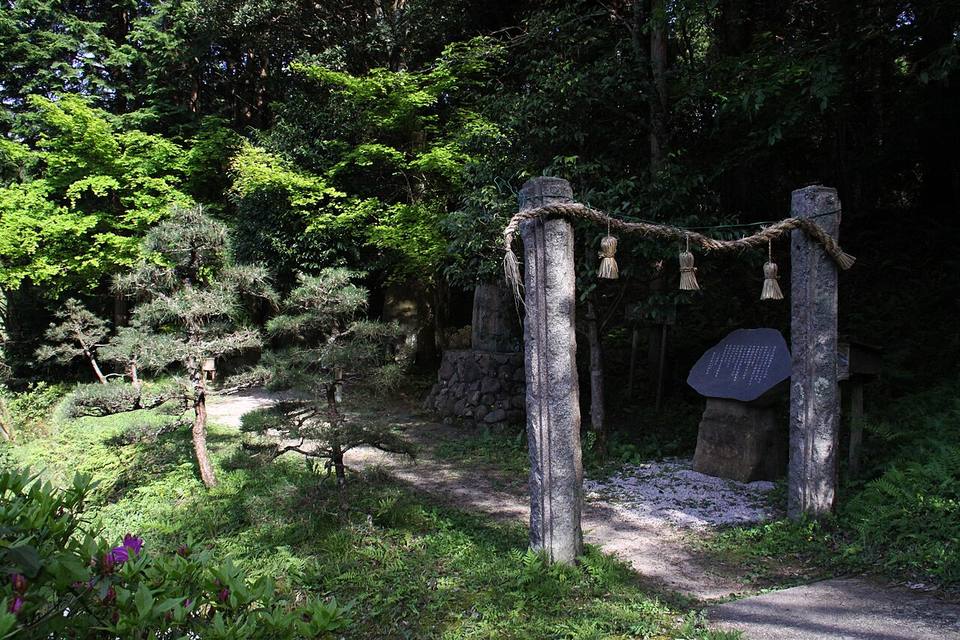
Found in the upper volume of the Kojiki (古事记), this is the most complete underworld narrative in Japanese mythology; volume 1 of the Nihon Shoki (日本书纪), in the Age of the Gods section, has variant texts (the details of the Yomi episode differ in fullness and must be read in comparison). The identified site of Yomotsu Hirasaka is in the Iya area of Higashiizumo Town, Matsue City, Shimane Prefecture — a "legendary site" of local tradition with a stele erected by the town, without archaeological confirmation; the nearby Iya Shrine (in Iya), whose main deity is Izanami, is the faith anchor of this identification. The married-couple cedar and the Mirror Pond divination at Yaegaki Shrine are another layer of Izumo love-seeking folklore — associated with this legend by shared locality, not part of the same text.
Customs
Yomotsu Hirasaka is a lane in a residential area — do not gather there at night and do not move the roadside stones "as a test of courage"; for the Mirror Pond divination you must place the prescribed coin on the divination paper, throw nothing else into the pond, and do not fish out other people's divination papers; shrine worship is two bows, two claps, one bow — but at Izumo Taisha it is two bows, four claps, one bow (see the explanation in Overview G2; at Izumo Taisha follow its rule) — Yaegaki and Iya shrines, covered in this entry, use the usual two claps.
Places you can visit
The legendary site of Yomotsu Hirasaka in Matsue City (the slope, the stele, and the peach statue); Iya Shrine; Yaegaki Shrine (the Mirror Pond divination paper, the married-couple camellia/cedars); Izumo Taisha (the hub of the Ōkuninushi lineage and the Izumo myth cycle; matters of the Kamiari month are as officially announced each year). Linking the four points makes the most sense as a half-day Matsue–Izumo line.
Image source · ChiefHira · CC BY-SA 3.0


