
Chinese Mythology · Bashu mythology.
Sanxingdui's Bronze Sacred Tree and the Protruding-Eyed Man
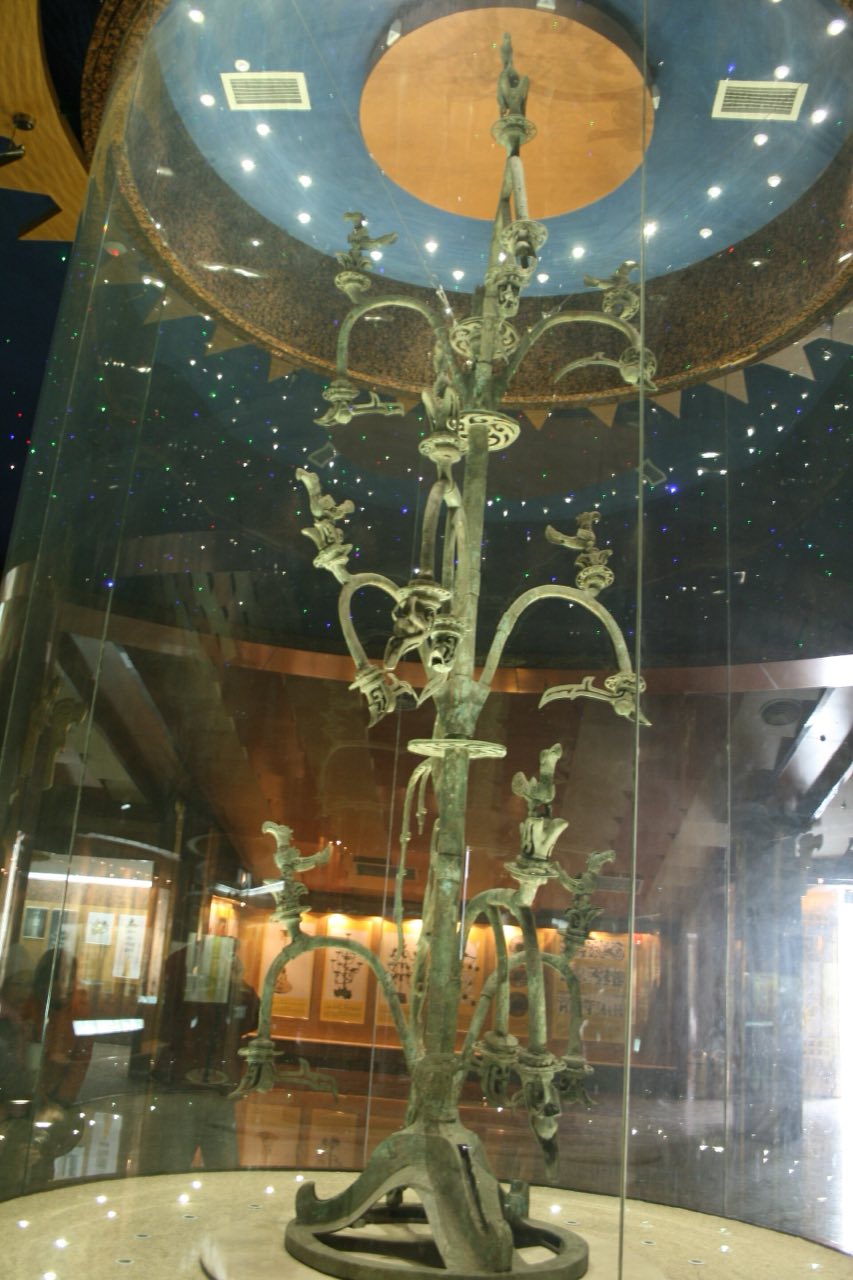
A bronze tree of three tiers and nine branches with birds on every bough: the ancient Shu people's ladder to heaven.
Stories and legends
The ancient Shu people worshipped a sacred tree that reached the sky. The tree had three tiers and nine branches, a sacred bird perched on each branch, a great dragon coiled around its trunk, and the sun turned into golden crows that rested on the branches and rose in turn each day from the east, so the sacred tree was a ladder joining heaven and earth. Another local telling connects this tree with Fusang in the Classic of Mountains and Seas, saying that ten suns rested on Fusang until Hou Yi shot down nine of them and left only one. Local legend also says that Cancong, the first king of ancient Shu, was born with protruding eyes that could see what ordinary people could not see, and that the protruding-eyed bronze masks unearthed at Sanxingdui show what he looked like, with the protruding eyes marking a person who could commune with the gods.
Origins of the story
The verifiable objects are the bronze sacred tree and the protruding-eyed masks unearthed at the Sanxingdui site. The No. 1 bronze sacred tree is 3.96 metres tall, was unearthed in 1986 from sacrificial pit No. 2, and was restored from more than 200 fragments. It has three tiers and nine branches, birds standing on the branches, and a dragon coiled beside the trunk, and dates to about the late Shang dynasty. The protruding-eyed masks, with eyeballs jutting out like columns, are among the most striking features of Sanxingdui bronzes. Whether the sacred tree was Fusang or Jianmu, however, has no settled answer in scholarship, only comparisons, and the Fusang reading and the Jianmu reading stand side by side as uncertain. Whether the protruding-eyed masks show Cancong himself is only an association later scholars made after reading the line about Cancong having protruding eyes in the Huayang Guo Zhi, and since the Sanxingdui people left no writing, this cannot be confirmed and remains uncertain. Claims about alien civilisations have no archaeological basis and cannot be accepted.
Places you can visit
When you visit the new building of the Sanxingdui Museum in Guanghan, Sichuan, you can see the No. 1 bronze sacred tree, the protruding-eyed bronze masks, and the large standing figure in the galleries, and guides at the sacred tree display often explain both the Fusang and the Jianmu readings. The museum also has a reconstruction of the sacrificial pits and a conservation workshop, and with luck you can watch restoration work through the glass. Visits require advance booking, and ticket prices and opening hours follow the official announcements.
Image source · The bronze sacred tree at the Sanxingdui Museum · Gary Todd · CC0
