
Chinese Mythology · Chu mythology.
Qu Yuan's Nine Songs: Xiangjun and Xiang Furen
Two river deities who long for each other across the Xiang River yet never meet: the most moving pair in the Nine Songs.
Stories and legends
Two deities lived above the Xiang River, Xiangjun and Xiang Furen, a pair of lovers kept apart by the vast Xiang waters. Xiangjun steered a boat of cassia wood and rowed with orchid oars, cut ice and piled snow, and gathered fragrant herbs, hoping to give the fragrant plants to his beloved. Xiang Furen built a dwelling in the water roofed with lotus leaves and framed with cassia beams and orchid rafters, spread with fragrant herbs, and waited quietly for the other. The two sang in turn and poured out their longing, yet in the end they still missed each other, leaving only the Xiang waters flowing on and fragrant herbs with no one to receive them.
Origins of the story
The verifiable texts are Xiang Jun, the third poem, and Xiang Furen, the fourth poem, in the Nine Songs of the Songs of Chu. Both began as witch songs for sacrifices to the deities of the Xiang River in Chu and were rewritten and polished by the Chu ci poets of the Qu Yuan school, with the poems dating to about the late Warring States period. The Eastern Han commentator Wang Yi identified Xiangjun and Xiang Furen as Shun and his two consorts Ehuang and Nüying, which is a Han-dynasty association. Most modern scholars hold that the two were originally the male and female water deities of the Xiang River and were only later joined to the legend of Shuns consorts, and the two readings stand side by side as uncertain. The claim that Qu Yuan wrote the poems himself is also not exact, since modern research holds that the Nine Songs came from court poets of Chu collectively rewriting sacrificial songs, and may not all come from Qu Yuan alone, which remains uncertain.
Places you can visit
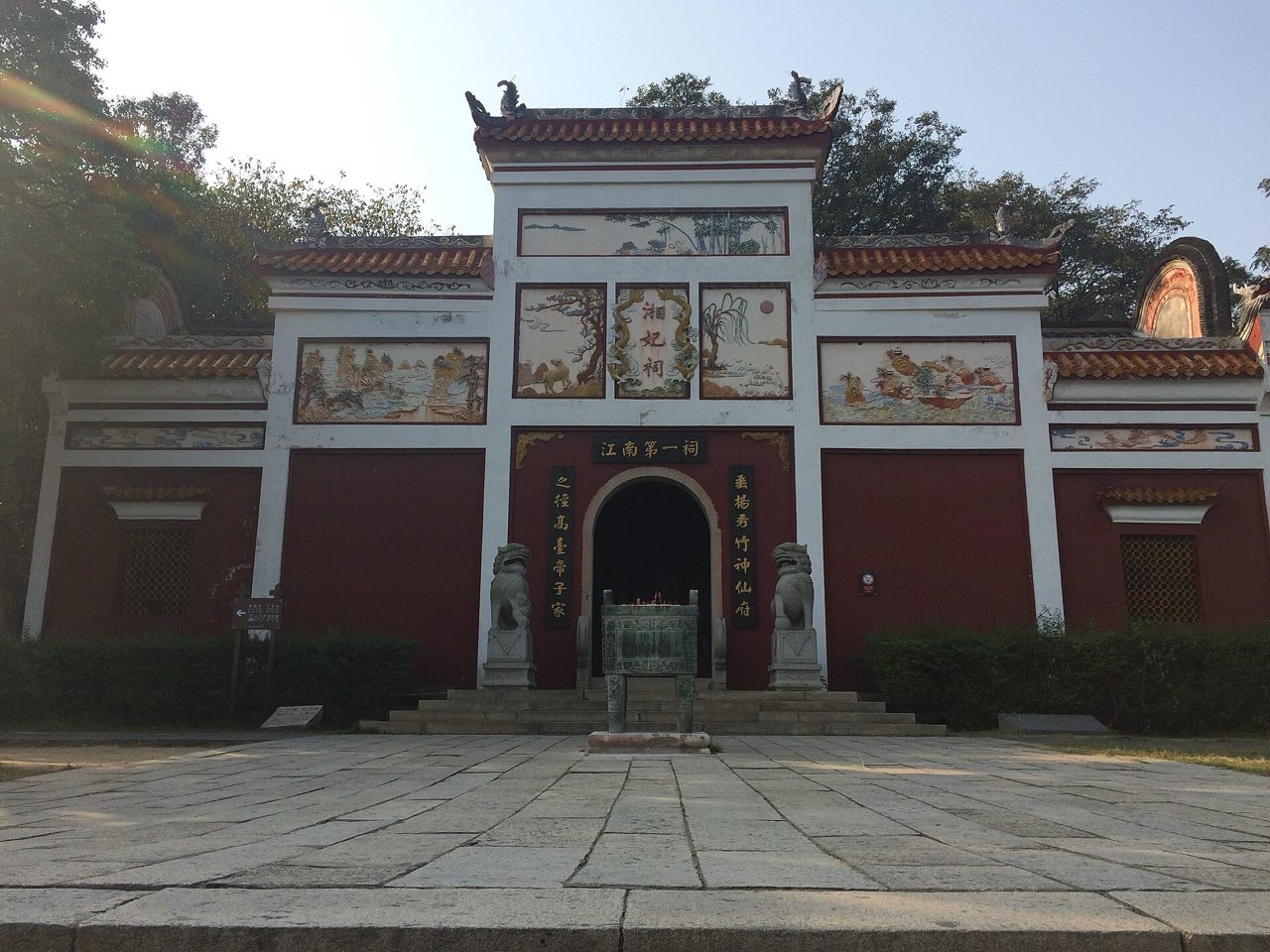
When you visit Junshan Island in Dongting Lake at Yueyang, Hunan, you can see the Xiangfei Temple and the tombs of the two consorts, and the island also has a grove of mottled bamboo named for the legend. Local legend says that the tears of the two consorts stained the bamboo stalks, though the spots are in fact fungal marks on the bamboo surface, not tear stains. Looking across the lake at Junshan Island from Yueyang Tower is a classic view of Dongting Lake. Reaching the island requires a boat, and boat fares and opening hours follow the official announcements.
Image source · The Xiangfei Temple on Junshan Island · Huangdan2060 · CC0
